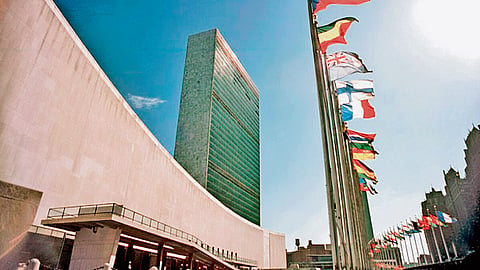

When Donald Trump signed an executive order a few weeks ago withdrawing the US from 66 international organisations, including 31 entities linked to the United Nations, he did not merely thin out America’s diplomatic footprint around the world. He took a wrecking ball to the architecture of global cooperation and consensus-building that Washington itself had designed and financed since the end of the Second World War. It was indeed a declaration of war on multilateralism.
The order severed US ties with a sweeping array of bodies spanning international security, law, trade, energy, climate, development and human rights. Among the victims is the UN Framework Convention on Climate Change, Global Counterterrorism Forum, International Energy Forum, and a string of UN-linked mechanisms such as Peacebuilding Commission and UN Population Fund. Washington also left the International Solar Alliance, led by India and France, that was unveiled by Narendra Modi and Francois Hollande at Paris in November 2015. The sweeping exits signal not only Trump’s contempt for collective governance but also his refusal to endorse international cooperation.
This purge comes on top of earlier exits from Unesco and the UN Human Rights Council, alongside the effective dismantling of USAID. It is being accompanied by slashes of more than $2 billion to the UN system, including an $800-million cut in peacekeeping funds. These moves have forced the organisation to shrink its peace missions by a quarter and prepare for staff cuts approaching 20 percent.
UN Secretary-General António Guterres regretted the decisions, but reiterated the organisation’s responsibility “to continue to carry out our mandates with determination”.
Trump’s retreat represents the arrival of what scholars now call the ‘world minus one’, a global order in which the world’s most powerful state remains economically and militarily dominant but is absent from, and increasingly hostile to, the system of rules and institutions that govern global cooperation.
The mythology of American indispensability has long held that multilateralism cannot function without Washington. Trump is now stress-testing that assumption by vandalising the system from within and then stepping outside it.
And yet, inconveniently for Trump, history shows that the world has been here before. The US opposed racial equality at the League of Nations, dragged its feet on decolonisation, refused to ratify the Law of the Sea Convention, voted against the International Criminal Court, and has repeatedly treated international law as optional. Global norms advanced nevertheless. Institutions endured. Multilateralism survived because it exists as an infrastructure of shared interests.
The same pattern is re-emerging. Despite Washington’s tantrum, the Paris climate agreement still binds most of the world’s economies. The International Criminal Court continues to operate despite US sanctions on its judges. Regional trade architectures are expanding. Trump is demolishing the facade of the house, but the foundations remain intact.
China is already the UN’s second-largest contributor, paying nearly 20 percent of the regular budget and almost a quarter of peacekeeping costs, and providing more peacekeeping troops than any other permanent Security Council member. Its trade architecture, particularly the Regional Comprehensive Economic Partnership and the upgraded China-Asean free trade agreement, is quietly anchoring the Asia-Pacific economy.
Russia, though far less capable economically, is also active in security-oriented multilateral forums and regional alliances that are increasingly used as buffers against US pressure.
Middle powers and regional coalitions such as Brics, the G20, Asean and the Shanghai Cooperation Organisation have become platforms for collective defiance of Trump’s tariffs and threats. Brazil has ignored US pressure over the prosecution of Jair Bolsonaro. South Africa has publicly rejected Washington’s claims of persecution of white citizens. India has expanded its trade architecture with Europe and Asia while maintaining strategic autonomy. African-led peace operations, funded largely by the European Union, are increasingly doing what shrinking UN missions can no longer afford to do.
The UN is financially wounded and politically bruised, but not irrelevant. It remains the only universal forum where democracies and autocracies still cooperate on humanitarian relief, development finance, global health and peacekeeping.
To survive, the UN must adapt. Core missions, including humanitarian relief, peacekeeping, mediation and development coordination, must be prioritised. It must mobilise private capital, philanthropic foundations and regional development banks far more aggressively. It must also persuade middle powers, from India to Brazil to Indonesia, that underwriting multilateralism is no longer optional if they want influence in shaping it.
The once-unthinkable proposal to move the UN headquarters out of New York deserves serious consideration—not as symbolism, but as insulation against American political hostage-taking through visas and access.
Will the US return? Possibly. But it will not return to the throne. Trump has broken the myth of American reliability. Even a future administration that seeks to repair the damage will find a world that has moved on, diversified its alliances and hedged against US caprice.
E D Mathew | Former UN spokesperson
(Views are personal)
(On X @edmathew)
