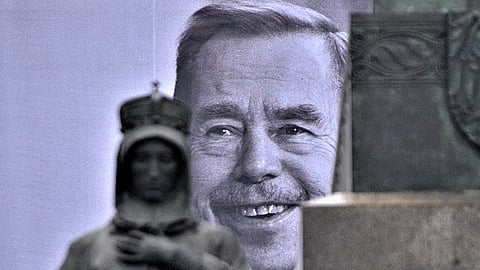

Who could have expected that news of the end of the world would be broadcast not from the UN General Assembly or a parliament, but from a talk-shop run by an NGO set up by an engineer? That’s what Davos is, actually. And who could have expected that 1970s’ vintage Václav Havel would be invoked to make sense of the news? Or that the news peg would be Arctic Greenland, whose vicinity has been in the news only because global warming is shrinking the permanent ice pack, with consequences for global weather? Only the Russians are pleased because their northern ports may become all-weather, and anyway, they’re tired of being cold and dreaming of holidays in Goa and Pattaya.
The Arctic is also important for aviation, and found its place in culture in Arlo Guthrie’s 1969 hit ‘Coming into Los Angeles’, which described his flight amid a planeload of chickens: “Coming in from London from over the pole/ Flying in a big airliner.” During the Cold War, ballistic missile flight paths between the US and the USSR also passed over those regions, hence the strategic importance of US assets in Greenland. But the Cold War is long over and though Moscow still owns more nukes, Russia is not the same as the USSR. In contrast, Xi’s China is greater than Mao and Deng’s China. The geopolitical landscape has changed.
Canadian PM Mark Carney and European Commission President Ursula von der Leyen turned a page in world affairs when they said at Davos that the crisis over Greenland and Nato is not a temporary aberration, and that the rules-based system and the idea of global governance are already history. Carney quoted Havel’s 1978-79 samizdat essay, ‘The Power of the Powerless’, which had travelled underground to Poland, where it provided the moral basis of the Solidarity movement.
Carney quoted Havel’s parable of a grocer who puts up a sign on his shop window every day that says: “Workers of the world unite.” Neither the grocer nor the observers believe in the Marxist slogan, but he puts it up in a ritual of compliance. The ritual is observed by all, and their mass compliance props up the totalitarian state.
Havel had alluded to the work of another now-forgotten dissident, Aleksandr Solzhenitsyn, who urged his readers not to live a lie. In Havel’s parable, when one of the millions of people propping up the lie by observing empty rituals just stops, the edifice of absolute power begins to crumble. Carney applied the logic to the post-war world, which had willingly worked towards common security. But in the face of annexation, it is time for the grocer to take down the sign.
Indeed, the idea of a grand Western alliance of equals was a lie, because after the colonial period, European powers declined while the US grew. The latter became the steward of a reasonably stable global system that protected the interests of lesser Western powers. It was flawed, but far more humane than the multi-polar network of spheres of influence it supplanted, in which it was easy to get away with murder in your own territory. Nations hesitated to intervene in the spheres of influence of others―which included their imperial possessions.
The Bengal famine of 1943 killed millions because Winston Churchill rejected international aid. The Allies were capable of shipping grain to Calcutta despite wartime rationing among their own people, but they hesitated to intrude without permission upon a British colony. A decade earlier, Stalin’s forced collectivisation policy had precipitated the Holodomor in Ukraine. In the press, the world saw pictures of starved people in the streets of Kharkiv, which was then the capital―a decade later, they would see similar scenes in the streets of Calcutta.
But Ukraine was part of the Russian empire, and nations and agencies that would have liked to help hesitated to cross a line. Similarly, the Western powers knew of atrocities committed by the Japanese for over three decades in Korea and Manchuria. They did not intervene for fear of having to tangle with Japan―until Pearl Harbour was attacked.
These are only a few of many humanitarian outrages which could have been contained, had not the great powers carved up the world into imperial territories and spheres of influence. The idea of an ‘international community’ developed after the Second World War and the founding of the UN. It is a legal fiction, but since it represents the union of national wills―often via the UN―it carries much more moral weight than individual nations, even those which lay claim to manifest destiny. This quality gave legitimacy to the coalition intervention in the Balkans, and to elements of the international community that have intervened in African conflicts from Biafra to Rwanda and Mali.
Now, as the collapse of Nato reorders the strategic landscape, and in the absence of an effective UN, there appears to be no nation which can lead a new international community or coalition. So the world is ready to fall back on the only alternative it knows―spheres of influence. The system permitted unbelievable violence against civilian populations in the pre-nuclear world. Now, with nine states owning over 12,000 warheads, it is unlikely to go anywhere except a dark place. But the rhetoric at Davos offers an opportunity to imagine a new, more globalised and more representative international community, instead of regressing back to the age of empires.
Pratik Kanjilal | SPEAKEASY | Senior Fellow, Henry J Leir Institute of Migration and Human Security, Fletcher School, Tufts University
(Views are personal)
(Tweets @pratik_k)
