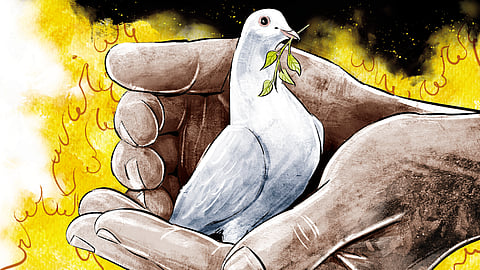

War is in the air. In films and the dialogues therein, in what passes these days for diplomatic dialogue, in conjecture and commentary, in commodity prices rising and falling. In Davos. Sometimes just about averting a specific one, though always on the verge of it somewhere or the other. A permanent Almost War. Thankfully, the takeover traffic light for Greenland has turned red for now.
The Danes can breathe easy. No immediate stocking up on war rations. Instead of being hit by a meteor on its western front, which was hitherto all quiet and really not even a front, Europe can refocus on its own suicide in the east. Ukraine, in turn, can refocus on counting allies and ammunitions to prolong its own moth’s flight path to flame.
Unconfirmed reports suggest China has sent no fewer than 16 Y-20 cargo planes to Iran, loaded with drones and missiles. Not exactly the Chengdu J-10C fighter jets that Tehran wanted last year, but war paraphernalia nonetheless. Our own Republic Day, too, is all set to display war formations this time—Sindoor and any forthcoming streaks of vermilion. The smell of conflict is everywhere on the body of peace.
Lo and behold, there was also the war over the Nobel Peace Prize itself, resolved unamicably—and with a vengeance strike against Venezuela to restore parity and soothe the nerves. The Norwegian Nobel Committee could have been a little more responsible in its choice. We have long excused Oslo for overlooking Gandhiji—that omission belongs to another era. But Trump? That was unfair. Poor man had to go Dutch with Machado. Much ado about something, backed by good collateral noise.
So much war rhetoric has social media looping endlessly, pulling the Cold War out of old storage. Historian John Lewis Gaddis, speaking to TV host (and Reagan-Bush Sr scriptwriter) Peter Robinson, warns that people, particularly the young, are forgetting wars, the Cold War included. In fact, forget that past, Gaddis points out gloomily that freshers at Yale have no inter-generational memory even of 9/11. The collapse of the Twin Towers simply lies beyond their experiential world! It’s been a quarter century, by the way, if you haven’t been checking your watch.
Maybe he’s being too optimistic? As if there’s any scope for history to fade even though we are overwhelmed by the present. But there’s also hope in that observation. One day, perhaps, there will be children and students in Gaza with no memory of conflict. They will float on a new Ark of peace, not tossed about by the currents of inherited trauma. History, after all, is not meant to be lived permanently in the present tense.
Our readers, however, have no memory loss. We have been firmly admonished by elders among them for not commemorating Subhas Chandra Bose’s and Swami Vivekananda’s 129th and 164th birth anniversaries befittingly. Our bad—we thought those contesting the West Bengal elections would do it for us. We should have known better. They were caught up playing Chinese whispers over ED raids and over who leaked what to whom. Far too busy with the war within—electoral, albeit.
Maybe people today—in particular, the ‘Gaddis youth’—are not interested in the theory and praxis of Bose or Vivekananda. Going by what is churned out in the public domain, there’s far more interest in their deaths. What new can be unearthed or imagined? How can mystery trump meaning?
There are those who still believe Bose never died—certainly not in a plane crash in Taiwan in 1945. Bose was the Indian nation-state’s first war hero. How could he have died quietly in a hospital from third-degree burns?
My former professor, Dr Purabi Roy, a four-starred general of Russian studies, is partly to blame for keeping this mystery alive. Few know Russian as well as Purabidi does (it’s fine to use the suffix di for her), except perhaps social scientist Sobhanlal Datta Gupta. When the KGB archives were briefly opened in 1992 after the Soviet collapse, they were among the first two scholars to enter and begin research. Purabidi returned with Bose resurrected. Prof Sobhanlal did not quite agree, but she would have none of it.
In the years since, she has placed Bose in various Russian locations—from dachas near St Petersburg to Siberian gulags—citing anecdotes, submarine escapades and her own research papers to bolster the tales. Over time, speculation acquired the weight of folklore. There are those who believe Bose returned to India and lived on as Gumnami Baba. By this account, Nehru kept him hidden but accorded him a gun salute on his death. History, here, bends willingly to belief.
As for Swami Vivekananda, who died young at 39 after predicting his own death, the contemporary retelling is no less dramatic. He’s now believed to have been driven to death by an insensitive society that failed to appreciate what he had done for the country and his religion. That he suffered from asthma and died of complications from severe diabetes, aggravated by fasting and an austere lifestyle, is deemed too tame a story for a figure of his stature.
His disciples and the Belur Math preach that he took samadhi—in other words, spiritual euthanasia. Why be mundane when you can go metaphysical? For those who prefer to nourish their absent memory cells with Upanishadic nutrition advice can consult his collected works.
Read all columns by Santwana Bhattacharya
Santwana Bhattacharya
Editor
santwana@newindianexpress.com
