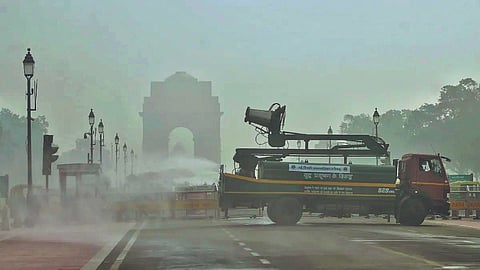

Air pollution in India is not only a cause for episodic panic; it is a systemic failure whose costs are staggering—in lost lives, lost productivity, rising healthcare expenditure and irreversible damage to children’s cognitive development. And despite decades of regulation, monitoring stations and court orders, the outcomes remain grim.
The uncomfortable truth is that we are trying to solve a 21st-century problem with 20th-century tools. This is where artificial intelligence-led technology can offer India not a miracle cure, but something far more valuable—governance intelligence at scale.
India’s pollution control architecture suffers from three structural weaknesses. First, data poverty masquerading as data abundance. Most cities rely on a handful of regulatory-grade monitoring stations to represent millions of people. These stations are sparse and often provide averages that hide hyperlocal realities. Pollution does not distribute evenly. A school near a traffic junction, a construction site or an industrial boundary may experience pollution levels several times higher than a city-wide average.
Second, reactive enforcement. Action is triggered only after pollution crosses thresholds. By the time bans are imposed, the damage is already done. Pollution control boards act like post-mortem examiners rather than preventive physicians.
Third, institutional silos. Transport departments do not speak to health departments; urban local bodies lack real-time feedback loops; citizens remain passive recipients of advisories rather than active participants in solutions.
AI-led systems directly address all three failures. Hyperlocal sensing using low-cost, calibrated sensors allows pollution to be mapped at street, ward and neighbourhood levels—sometimes down to a few hundred metres. When combined with AI-driven calibration, sensor fusion and anomaly detection, these networks can achieve accuracy that is decision-grade, not merely indicative.
But sensing alone is insufficient. The real leap comes from predictive intelligence. AI models trained on historical pollution data, weather patterns, traffic flows, industrial activity and land-use changes can forecast pollution spikes days in advance. This allows city administrators to act before air quality deteriorates—rerouting traffic, rescheduling construction, modifying industrial operations or issuing targeted health advisories.
One of the least discussed advantages of AI is its ability to depoliticise enforcement. When pollution hotspots are algorithmically identified, violations can no longer hide behind averages or excuses. Construction sites exceeding dust thresholds, industries breaching emission norms, or roads generating abnormal particulate levels become visible in real time.
AI-enabled dashboards can automatically trigger inspections, fines, or corrective actions—reducing discretion, delay and rent-seeking. Over time, this creates a culture where compliance is cheaper than violation.
For municipal bodies struggling with manpower constraints, this is critical. AI does not replace officials; it amplifies their reach.
Air pollution is not only a regulatory problem; it is a civic one. AI-led platforms can democratise access to environmental intelligence. Citizens can receive personalised exposure advisories based on local air quality, and even get route suggestions based on cleaner air pathways. Parents can make informed decisions about outdoor activities for children; patients with respiratory illnesses can plan their day with precision.
More importantly, citizens can become sensors and stakeholders, not just sufferers. Crowdsourced data, grievance reporting, and behavioral nudges—powered by AI—create feedback loops that strengthen governance rather than weaken it. This is where technology meets trust.
The biggest gains from AI-led pollution control may lie outside the environment department. Health systems can anticipate spikes in respiratory admissions. Schools can adjust schedules proactively. Employers can redesign work hours during high-exposure periods. Insurers can price risk more accurately and incentivise preventive behaviour.
In economic terms, cleaner air is not a luxury—it is a productivity multiplier. Even marginal reductions in pollution translate into billions saved in healthcare costs and lost workdays. AI enables these cross-sector linkages by acting as a shared intelligence layer across government.
India does not lack pilots; it lacks platforms. Across the country, innovative pollution-tech solutions exist—some built by startups, some by academic institutions, some by civic entrepreneurs. But they remain fragmented, localised and often dependent on individual champions. What India needs is a national environmental intelligence backbone—interoperable, open and scalable—where states, cities and agencies plug in rather than reinvent the wheel. Just as digital public infrastructure transformed payments and identity, environmental intelligence must become a public good.
Crucially, this system must be Indian by design—trained on Indian data, adapted to Indian urban forms and governed by Indian institutions. Outsourcing our environmental intelligence would be as dangerous as outsourcing our defence intelligence.
AI cannot substitute hard decisions on urban planning, energy transition or public transport. But it can remove excuses. When evidence is real-time, granular and undeniable, inaction becomes a choice.
India stands at a moment where technology, talent and urgency converge. Air pollution is not an unsolvable problem; it is an unmanaged one. If we deploy AI not as a buzzword but as a governance tool, India can move from crisis response to clean-air resilience.
Pravin Kaushal | Founder of RaastaFix and Member of Government Liaison Task Force at IIT Kharagpur who is working on scalable solutions to solve India’s air pollution
(Views are personal)
