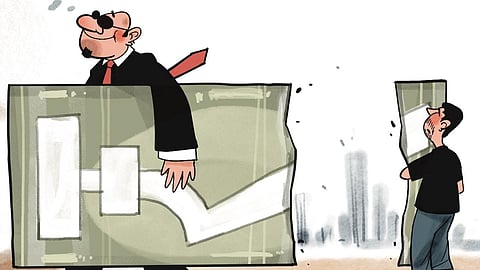

The ubiquity of platforms and the sharing economy is evidenced by the fact that brands like Uber and Airbnb are now used as verbs in everyday vocabulary. Their products—taxis and rooms for hire—are established. The novelty is in the ‘platforms’ matching users and providers online using peer-to-peer systems. The sharing economy—the Orwellian term used to describe the phenomenon—is focused on transport (Uber, Lyft, DiDi), short-term accommodation (Airbnb) and food delivery (Uber Eats, DoorDash, Deliveroo). The concept is universal, allowing platform companies to operate globally to defray costs across a larger revenue stream.
The approach targets a regulated industry with decent margins, attacking incumbents and existing operating models. The suppliers are typically non-traditional. Instead of trained drivers, ordinary individuals use their own cars to ferry passengers to and from destinations. Surplus accommodation, such as empty homes or spare rooms, substitute for traditional hotels.
The platforms lower the cost, increasing access to consumers who may not traditionally use the services. This is achieved in several ways. It is theoretically ‘capital-lite’. The platform acts as a broker, avoiding investment in the assets needed to provide the service. Uber drivers must provide the vehicle. Airbnb hosts own the property. Delivery drivers mostly use their own transport. It minimises the need for fixed costs such as premises.
Labour costs are reduced by the legal ruse of converting employees to independent contractors, avoiding laws specifying minimum wages, loadings for out-of-business hour work, maximum working hours or mandatory breaks, sickness leave, holidays, training costs and other benefits such as health coverage in some places. There is arbitrage of regulatory frameworks. Traditional providers must comply with requirements for licensing, insurance, training, occupational health and safety and minimum service standards. The platforms use the disingenuous argument that they are not in the transport or accommodation business to avoid these standards.
The sharing economy is best thought of as farming out services to the cheapest producer, like outsourcing goods production to emerging markets to take advantage of lower cost.
The platforms undermine existing industries by cannibalising revenues. Uber’s revenues are at the expense of taxis and hire cars unless they can grow the overall market. Other than in locations with poor transport options, this has not been significant despite claims by ride-share companies. The position with hotels and other accommodation providers is similar. It reduces the value of existing franchises with the price of taxi licences and share price of hotel firms having fallen wherever such platforms operate.
Food delivery services may have expanded the market and reach of restaurants although setup costs, marketing fees and commissions payable to platforms, ranging from 15 to 30 percent, can significantly impact restaurants’ profit margins, especially where they are small. It has also changed eating habits with consumers increasingly addicted to convenience leading to an offsetting decline in purchase of food ingredients and falls in nutrition quality. It has also influenced industry structure with some larger restaurants creating ‘ghost kitchens’ focused on online deliveries to lower costs.
As with many digital innovations, the sharing economy’s economic benefits are overstated.
Cannibalisation means that overall sector revenues may be unchanged. Even if volumes increase, lower cost reduces the overall income. Using existing unused assets is environmentally desirable but reduces investment in and purchases of new productive capacity. Where the State compensates existing providers, such as taxi and hire car licensees, for the diminution of value of licences the sharing economy is effectively subsidised by taxpayers. Any benefits may be offset by the disclosure of personal data, loss of privacy, cybercrime and security expenses to protect data and electronic payments.
The sharing economy entails a redistribution of income and wealth from providers and employees to customers. Service providers in advanced economies earn the minimum wage at best. In emerging economies, platforms may provide income opportunities where there is no other formal employment available. Earnings frequently do not take into waiting times and expenses such as fuel and unpaid labour. Fixed cost elements, such as capital investment, depreciation, insurance and maintenance, may not be properly factored into the charges. Providers face precarious existences and uncertain income always exposed to online reviews and rating systems, irrespective of validity or fairness, which can deactivate them, excluding opportunities for future work.
Employees of the platforms are in no better position as they trade-off low wages in return for shares options of uncertain value linking their futures to the success of the venture and the vagaries of markets.
Investors may also lose out as few businesses that have emerged from this model are profitable. While it’s now profitable, Uber has lost over $31 billion since inception and may never fully recover these losses. It claims it needs to be bigger. Given that it operates in around 70 countries and has over 100 million active users, it is unclear what the required scale is.
The losses reflect investment in software development and hardware, customer acquisition expenses and start-up losses. The financial strategy is to raise enough capital to fund this strategy and eventually emerge as the last firm standing in the sector when their newly-acquired pricing power allows the survivor to raise prices. But the market is highly contestable because there is no clear protective moat. The technology is easily replicable or vulnerable to replacement by newer ones. Many countries have their own online ride-share and short-term accommodation options. Herd-like venture capitalists are happy to finance copycat firms in each sector, making it difficult to reach profitability.
The cost advantages are already eroding as increasing regulation brings platforms into line with incumbents, who are also investing in competitive products. To the extent that the model relies on available pools of labour and unused assets, these surplus resources logically must ultimately be exhausted or re-priced.
The platform companies illustrate how modern digital innovation enriches a small group of promoters while leaving others to struggle in what former US Labour Secretary Robert Reich called the “share the scraps” economy. It does not engender progress, instead taking society back to earlier exploitative times and condemning most to piecework labour.
Satyajit Das | Former banker and author
(Views are personal)
