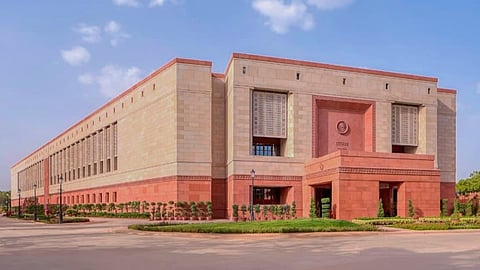

Sonia Gandhi’s article, “An Education System’s Collapse, Young India’s Trauma”, is long on rhetoric but remarkably short on accountability. It seeks to indict the Government while ignoring the most important fact: Parliament is in session, the prime minister has announced a Bill to strengthen India’s legal framework against paper leaks, and Congress, led by the article’s author, has spent the last four days disrupting proceedings instead of debating the legislation.
There is an obvious contradiction here. One cannot demand parliamentary deliberation through a newspaper editorial while preventing it inside Parliament. Laws are made in the House, not on opinion pages. Editorials do not prosecute those who leak examination papers, restore students’ lost academic years or strengthen institutions. Legislation does. If Congress believes it has a better solution to protect India’s students, it should bring its amendments to Parliament instead of substituting slogans for serious legislative engagement.
The central accusation in Sonia Gandhi’s article is that the Modi government has deliberately evaded accountability on education. The record suggests the opposite. When the NEET examination was compromised, the government did not defend a tainted process. It cancelled the examination, conducted one of the largest re-examinations in India’s history for over 22 lakh candidates, ensured admissions were not delayed, transferred the investigation to the CBI, secured arrests, and announced stronger legal safeguards, including fast-track courts.
Accountability is measured by action, not speeches. Cancelling a compromised examination, protecting honest students, prosecuting offenders and strengthening the law is what accountability looks like.
The article repeatedly invokes the figure of 152 paper leaks over the past twelve years, including nine involving the National Testing Agency. Yet the arithmetic undermines its conclusion. If only nine of the 152 incidents involved the NTA, then 143, nearly 94 per cent, occurred under state examination boards and recruitment agencies across governments of every political persuasion, including those in Congress-ruled states.
Paper leaks did not begin in 2014; they have plagued India’s examination system for decades. The difference is that India now has, for the first time, a dedicated national law against organised examination fraud. The Public Examinations (Prevention of Unfair Means) Act, 2024 introduced stringent imprisonment and penalties of up to `1 crore. When the 2026 examination was compromised, it was cancelled, re-conducted under the heaviest security architecture ever deployed, and followed by arrests and prosecutions. Previous governments largely responded with investigations and re-examinations; this Government has sought to build a permanent institutional framework to prevent them.
Equally selective is Sonia Gandhi’s criticism of the National Testing Agency. She argues that it lacks parliamentary accountability while omitting that the proposal for a national testing agency was first conceived by the UPA Government in 2013. The Modi Government operationalised it and is now taking the next step through the Viksit Bharat Shiksha Adhishthan Bill, before a Joint Parliamentary Committee, to replace multiple regulators with a statutory framework created through Parliament. In other words, the Government is legislating precisely the accountability that the article claims is absent.
The editorial’s treatment of education spending is equally misleading. It points to a decline in education’s share of the Budget while ignoring that education has received the highest allocation in India’s history—`1.39 lakh crore in 2026–27, including `55,727 crore for higher education. As the overall Union Budget expands, percentage shares naturally change. What matters is actual investment in scholarships, institutions, research, digital learning and educational infrastructure, all of which have expanded over the past decade.
The claim that the Modi Government has shut nearly one lakh public schools is similarly devoid of context. School administration is a State subject, and governments of different political parties have consolidated schools with low enrolment into neighbouring institutions with better infrastructure. That is an administrative response to demographic change and migration, not evidence of a centrally directed assault on public education.
The article’s assertion that graduate unemployment averages around 40 per cent also deserves scrutiny. Official Periodic Labour Force Survey data places graduate unemployment far lower, while the frequently cited 40 per cent figure comes from a narrow age cohort in a specific study. Graduate employment remains a structural challenge rather than one unique to the last decade. Meanwhile, India has seen over 2.35 lakh recognised startups, millions of startup-linked jobs, employment through Production Linked Incentive schemes, and a major expansion of Skill India and PMKVY.
Perhaps the most troubling aspect of the article is its treatment of police action.
Sonia Gandhi writes that pellet guns were “undoubtedly” authorised by the Union Home Minister. That allegation has been denied and remains before the courts.
Public figures have a responsibility to distinguish between allegations and established facts. Similarly, the article alleges that the NTA relies on politically affiliated “mediocre” experts and that authorities profit from the examination system, without supporting evidence.
Most strikingly, the editorial ignores the broader transformation underway in Indian education through the National Education Policy, digital learning platforms, scholarship reforms, expansion of premier institutions and Skill India.
None of these structural reforms finds meaningful mention in the article.
India’s education system undoubtedly faces challenges, and no government should pretend otherwise. But criticism acquires credibility only when solutions and acknowledgement of facts accompany it. At a time when Parliament is considering legislation that directly addresses examination malpractice, the country deserves serious debate rather than selective outrage. The Government has responded to failures with legal reform, institutional strengthening and technological safeguards. The Opposition has responded by obstructing Parliament while demanding debate elsewhere.
The invitation remains open. If Congress has a better law to protect India’s students, let it bring its proposals to Parliament. That is where democratic accountability is exercised, reforms are enacted, and students’ futures are secured. Editorials may shape opinion, but only Parliament can change the law.
Amit Malviya,
National head of BJP’s information & technology dept and co-incharge of West Bengal
