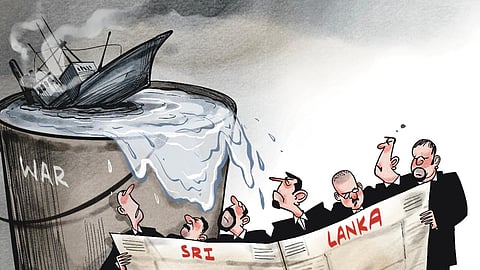

The West Asia conflict spilled over into the Indian Ocean with the US sinking Iranian warship IRIS Dena on March 4 within Sri Lanka’s Exclusive Economic Zone (EEZ). The frigate, which had participated in a multinational naval exercise at Visakhapatnam, was struck by an American torpedo 40 nautical miles south of Galle. At a Pentagon briefing, US Secretary of War Pete Hegseth confirmed the sinking that killed 87 people, claiming this was the first torpedo attack since the Second World War.
The day after, IRINS Bushehr, another Iranian ship carrying 208 crew members, reported engine failure and was allowed to dock at Trincomalee on humanitarian grounds. That evening, in a carefully worded address, President Anura Kumara Dissanayake articulated the country’s wish to remain neutral while responding to humanitarian crises.
The incidents hold serious strategic, political, economic and security implications for Sri Lanka and the broader region.
The island’s geographical setting, often seen as a blessing, also draws it into naval geopolitics, making it hard for Colombo to carefully balance diplomacy, maritime security and neutrality. Defence experts in Colombo insist that Sri Lanka was guided by international maritime obligations under the UN Convention on the Law of the Sea, and the international conventions for the safety of life at sea and for maritime search and rescue as it responded to the distress calls and undertook rescue for human safety.
The frigate’s sinking has widened the conflict zone that mainly involved the US, Israel and Iran, and dragged Sri Lanka and even India closer to it. The incident within Sri Lanka’s EEZ pushed the military confrontation into the island’s immediate maritime neighbourhood, and placed it in a vulnerable spot as the Indian Ocean region may now have to brace for the increased risk of naval activity, surveillance and military incidents. Handling this will pose a major diplomatic challenge while maintaining security cooperation with the US.
As the war moves closer to Sri Lanka, major powers may strive to increase their presence in the Indian Ocean, turning it into a zone for heightened monitoring. Sri Lanka’s strategic location along one of the busiest shipping routes in the world is likely to come under intense pressure, rendering its choices less flexible. It will prove doubly harder to maintain neutrality amid such competing interests.
It is possible that the US would expect Sri Lanka not to assist Iran and its allies under any circumstance, whereas Iran may want to rely on Sri Lanka, whenever the need arises, calling for a precarious balance between a friendly Asian state and Western allies.
The frayed nerves were on display on Friday, when the US embassy in Colombo swiftly clarified on a social media post on visa assistance that it was not a travel advisory update, which has remained at ‘Level 2: Exercise increased caution’ since last October. But it is too early to assume how the US would respond to Sri Lanka’s rescue of Iranian sailors and allowing the docking of another distressed vessel. Sri Lanka should maintain strict neutrality as any perceived bias could strain relations with either the US-led bloc, or Iran and its supporters
For the region, the developing situation signals an immediately increased security risk. If the conflict intensifies, it could result in more submarines and warships operating in the region, a higher risk of military miscalculations and maritime surveillance around shipping lanes. Unlike at present, the Indian Ocean may turn into a covert war zone with more submarine patrols and military exercises, requiring Sri Lanka to face the risk of both increased incidents and intelligence operations.
The region will also face commercial consequences including rising war-risk insurance premiums for ships, higher freight charges, and changes in shipping routes made by maritime companies. Sri Lanka heavily depends on maritime trade, port traffic and energy imports. If the conflict spreads, the Colombo, Hambantota and Trincomalee ports may see changes in shipping patterns and an immediate loss of revenue.
Meanwhile, defence experts warn that though Colombo’s limited capability to detect submarines or undertake other maritime surveillance may suffice in peacetime, if there is an escalation in the conflict, it would require to urgently modernise its fleet and beef up cooperation with regional navies to maintain security across the Indian Ocean. In such a scenario, India may well want to increase naval patrol near Sri Lanka, expand maritime cooperation and push Sri Lanka to limit other foreign military presence in its waters.
While recent incidents have highlighted Sri Lanka’s strategic importance, its geostrategic location also renders it vulnerable. Sri Lanka may now become more important for naval monitoring, a logistics point for humanitarian or security operations and, most importantly, an area of greater strategic competition among global powers. These competing interests will make it difficult for the island to maintain its conservative neutrality against an increasingly challenging global geopolitical scenario.
At home, there are increasing domestic political debates and security concerns about the island being dragged into great-power rivalries with its neutral stance even likely to be openly challenged. Sri Lanka’s own security preparedness and the possibility of coming under attack from the US for any perceived assistance, humanitarian or otherwise, to Iran can create a security nightmare for the entire region.
Sri Lanka has been an advocate of maritime peace. Initiated by the then Prime Minister Sirimavo Bandaranaike, the UN General Assembly in December 1971 adopted a resolution declaring Indian Ocean a ‘Zone of Peace’. It aimed to eliminate great-power military presence, especially nuclear weapons, to ensure security, sovereignty and regional peace. The resolution also called for the elimination of military bases, installations and weapons of mass destruction and to avoid the use of the Indian Ocean for threats against littoral or hinterland states while assuring the right to unimpeded use by all nations.
Bandaranaike’s farsighted non-aligned policy to maintain peace in the Indian Ocean, adroitly balancing competing interests, may prove a hard act to follow in these geopolitically seismic times. The implications are for the entire region to face. It’s a moment to pull together for collective security.
Dilrukshi Handunnetti | Award-winning journalist and lawyer; founder and director of Colombo-based Center for Investigative Reporting
(Views are personal)
(dilrukshi@cir.lk)
