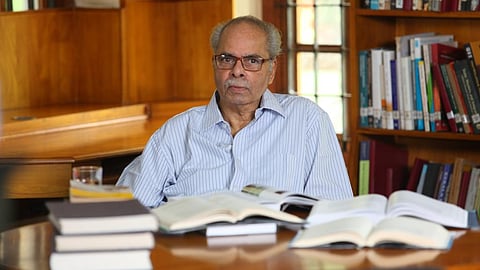

What a privilege—and a responsibility—it is for a student to speak about Professor K N Panikkar on the occasion of his passing. Writing about Professor Panikkar invites reflection on two intertwined aspects of his life: his work as a historian and his role as a public intellectual who helped shape how historians and readers engage with the past and understand modern India.
When Professor Panikkar began his scholarly work at the Centre for Historical Studies, Jawaharlal Nehru University, the study of modern Indian history was still largely centred on elite political narratives of colonialism, the Congress movement and constitutional developments. His work, however, asked a different question: what processes were unfolding beneath the formal political surface?
In works such as Against Lord and State: Religion and Peasant Uprisings in Malabar, 1836-1921, he examined agrarian struggles, peasant resistance and the complex social world of colonial Kerala. He showed that resistance was not merely nationalist but also social—directed against landlordism, caste hierarchy and state authority. In doing so, he helped broaden the understanding of nationalism by locating it within wider social processes.
Within the larger landscape of Indian historiography, he belongs to a generation that significantly reshaped the study of modern Indian history in the late twentieth century. This shift moved the discipline from political narrative towards social history; from nationalist teleology towards structural analysis; and towards a greater recognition of historical agency among ordinary people.
Professor Panikkar’s scholarship on social reform movements, particularly in Kerala, remains an important contribution. He approached reform not simply as moral uplift but as a form of ideological contestation. In Culture, Ideology, Hegemony: Intellectuals and Social Consciousness in Colonial India, he explored how colonialism operated not only through political domination but also through cultural and intellectual processes.
His work drew from Marxist historiography but was never doctrinaire. He engaged, for instance, with insights associated with Antonio Gramsci—particularly ideas about cultural agency, ideological struggle and the making of consent. Through such approaches, he highlighted how modernity in India evolved through negotiation rather than simple importation.
One of Professor Panikkar’s important public contributions was his defence of secular and critical historiography. In Communalism in India: History, Politics and Culture and in numerous essays, he argued that communalism should be understood not merely as religious sentiment but as a modern political ideology.
He consistently maintained that history should not be used to manufacture political identities or reduce the past to civilisational conflict. For him, secularism was not the denial of religion but a democratic framework for regulating power in a plural society. At moments when the writing of history itself became a subject of political contestation, he remained a thoughtful and steady voice for methodological rigour and critical inquiry.
Beyond his scholarly work, Professor Panikkar also played a significant institutional role. As chairperson of the Kerala State Higher Education Council, he contributed to discussions on educational policy and the relationship between academic work and social responsibility. He believed that scholarship should not remain confined to academic forums. His writings in newspapers, public lectures and policy engagements reflected a scholar attentive to the wider responsibilities of intellectual life.
As his student, I must also speak of the classroom. Professor Panikkar did not simply deliver lectures; he posed questions and problems. He encouraged us to read critically, examine sources carefully and situate ideas within their social and material contexts. He reminded us that history is not about memorising events but about understanding structures, contradictions and change.
Many of us continue to carry aspects of that method in our own work—perhaps the most meaningful legacy a teacher can leave.
A Personal Note
For many of us, Professor Panikkar represents more than scholarship alone. He stands for intellectual seriousness and a commitment to critical inquiry. Even at ninety, he remained an active presence in discussions on history, society and public life. As we condole his demise, we share our condolences with his family and remember a lifetime devoted to historical scholarship and public engagement. Professor Panikkar’s work reminds us that history is not merely a record of the past, but an ongoing conversation about society, democracy and the future.
Rajan Gurukkal | Historian and social scientist; Vice-Chairman, Kerala State Higher Education Council
(Views are personal)
