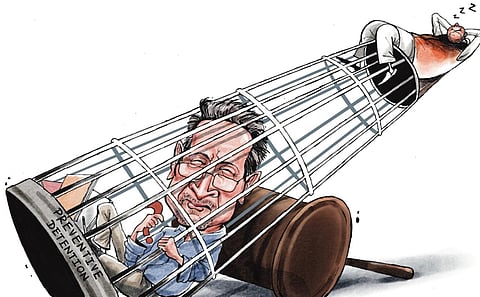

The continued detention of Sonam Wangchuk poses vital questions about the legitimacy of India’s preventive detention laws. Two aspects are significant. First, despite the habeas corpus petition filed by his wife, Gitanjali Angmo, which the Supreme Court has been considering for over 150 days, Wangchuk remains in prison. By its very nature, a writ of habeas corpus is intended to secure the immediate release and production of the detained person. The Supreme Court’s keeping of the petition pending for such a prolonged period undermines its purpose. Secondly, as is common in any detention based on mere suspicion and anxiety, the climate activist is detained without trial on the basis of an administrative report under the National Security Act.
The law of preventive detention in India has a disturbing history. In A K Gopalan (1950), the Supreme Court substantially validated the erstwhile Preventive Detention Act, finding fault only with Section 14, which prohibited disclosure of the grounds of detention even to the court. The Act enabled the Centre to detain citizens on grounds of security and public order. The court in A K Gopalan practically endorsed the detention of the communist leader, who had suffered incarceration under the British.
A K Gopalan epitomised one of the first illiberal judgements of the Supreme Court of India. The detention was challenged for breaching Articles 14, 19 and 21, which guarantee equality before the law, freedom of expression and protection of life and personal liberty. Additionally, Gopalan relied on Article 22, which provides protection against arrest and detention in certain cases. But the court overruled these contentions. The law laid down in A K Gopalan, however, was overturned in Maneka Gandhi (1978), which addressed the interplay between fundamental rights and upheld their centrality in the lives of citizens. A K Gopalan was decided at a time when the Congress government’s majoritarianism sought to restrict oppositional liberty, while Maneka Gandhi was decided when the country rescued itself from the clutches of the Emergency.
Article 22(3) implies that the legislature may enact a law to facilitate preventive detention. Article 22(4) prescribes a three-month time limit for such detention and permits extensions based on the report of an advisory board. This is the constitutional foundation for draconian enactments like the Preventive Detention Act, 1950; Maintenance of Internal Security Act (MISA), 1971 and National Security Act, 1980. B R Ambedkar’s optimism regarding Article 22 (Article 15A in the proposed draft) was based on other constitutional provisions that stipulate due process before arrest and detention. Members like Thakur Das Bhargava and Mahavir Tyagi warned that this constitutional indulgence could enable future draconian laws. Their criticism was not merely legal—it was ethical, historical and political. It was a prescient warning against the rise of an illiberal state.
Indian preventive detention laws ultimately proved Ambedkar wrong and his critics right. The communist leader, who had been incarcerated under the British, became a victim of the first preventive detention law which the Supreme Court endorsed. History, like an Orwellian novel, reveals ironies in political powerplay, often annihilating even the surviving idea of justice. Parliament repealed the 1950 Act in 1969.
Then came MISA, which led to the incarceration of thousands of opposition leaders during the Emergency. This Act was later repealed in 1978 by the Janata Party regime. The dispensations that discarded the idea of freedom and sought to suppress dissent and dissidents were clearly on the wrong side of history. Judicial endorsement of such State actions met a similar fate, reinforcing the principle that law cannot always shield injustice when it serves political expediency.
Now, back to Wangchuk. Neither the Centre nor the Supreme Court had the organic sensibility to learn from India’s legal history on preventive detention. They could not learn from their own egregious follies. Wangchuk was arrested on September 26, 2025 and the case has been repeatedly adjourned since October 6, 2025. Continued detention for over five and a half months, without trial or conviction, of the Magsaysay Award-winning climate activist, demonstrates the precarious state of our democracy.
In Wangchuk’s case, breach of the provisions of the 1980 Act was demonstrated, though the validity of the statute itself was not challenged. The National Security Act empowers the State to detain anyone agitating for political causes on vague grounds like ‘security of India’ and ‘maintenance of public order’. It grants unfettered powers to state governments, district magistrates and police commissioners. Moreover, the provisions governing execution and validation of detention orders are highly stringent. Section 5A provides that a detention order will remain valid even if some grounds are vague, irrelevant, unconnected or otherwise invalid. It was argued that this is subservient to Article 22, which imposes broader safeguards against preventive detention. Based on Section 8 of the Act, it was contended that non-disclosure of the grounds would vitiate the detention.
It was shown that the detaining authority—district magistrate—without application of mind, merely copied and pasted the recommendations of the Ladakh administration. The court was told that there were no materials linking Wangchuk to the allegations. The demand for statehood for Ladakh is a political slogan, not divisive or partisan. Many such demands have arisen in the past across India, yet Centre’s response in Wangchuk’s case has been disproportionate and politically charged.
The repeated adjournments in Gitanjali’s petition reflect poorly on the court. The case has been adjourned again until next week. Meanwhile, Gitanjali stated that once Wangchuk is released, he will not pursue even the path of peaceful agitation. This demonstrates the fragility of freedom and the limits of expression in practice, despite constitutional guarantees.
As of now, what is awaited is not even a final judgement. It is judicial statesmanship. And even if it occurs, it will be undermined by the delay it has taken to manifest. Wangchuk’s continued detention thus serves as a stark reminder of the tension between the rule of law and the exercise of unchecked power under preventive detention statutes. It underscores the urgent need for the State and judiciary to reconcile legal procedure with justice and human rights.
Kaleeswaram Raj | Lawyer, Supreme Court of India
(Views are personal)
(kaleeswaramraj@gmail.com)
