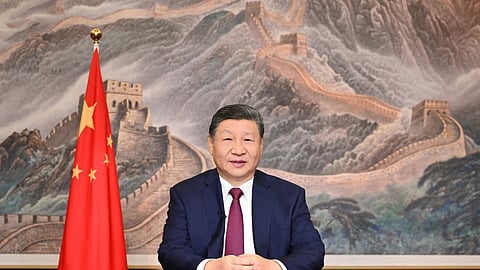

The Two Sessions, namely the annual plenary sessions of the National People’s Congress and the National Committee of the Chinese People’s Political Consultative Conference, have always served as a crucial window for observing China. This year’s gatherings are particularly noteworthy, as they mark the beginning of China’s 15th Five-Year Plan and coincide with a period of turbulent international dynamics and the surging tide of artificial intelligence.
I have recently returned from China after participating in the Two Sessions, with a clearer perspective on the trajectory of China’s future development. I would like to share with my Indian friends four of the most salient signals, along with some reflections arising from them.
Firstly, this year’s Government Work Report sets China’s annual growth target at 4.5-5 percent. In the eyes of some observers, this is the lowest growth expectation in nearly four decades and may seem somewhat ‘overly conservative’. In my view, this target reflects a prudent and pragmatic policy approach against the broader context of China’s economic transition. It does not pursue high speed; instead, it emphasises high quality. The underlying logic is to facilitate an orderly transition from old to new growth drivers, thereby creating greater policy space for structural adjustments, systemic risk prevention and deepening reforms during the 15th Five-Year Plan period. China’s economy is actively transitioning from high-speed growth to high-quality development.
As macro policies continue to take effect and a series of deep-seated reforms are implemented step by step, China’s economy is expected to gradually reduce its excessive reliance on investment and exports. A new pattern is set to emerge, with domestic consumption taking the lead while technological innovation adds impetus. This will enable the economy to sustain reasonable growth while enhancing the quality of development.
Notably, this target is also consistent with China’s long-term objectives through 2035. As outlined at the Fifth Plenary Session of the 19th Central Committee of the Communist Party of China, by 2035, China’s per capita GDP is projected to reach the level of a moderately developed country. According to calculations by several economists, this goal can be achieved as long as China’s economy maintains an average annual growth rate of above 4.17 percent over the next decade. Therefore, this year’s growth target embodies a prudent and rational assessment while signalling confidence in the long-term positive trajectory of China’s economy.
Second, the Government Work Report once again highlighted artificial intelligence as a keyword. For the first time, the report introduced the concept of “creating new forms of smart economy”. The essential goal is to seize the revolutionary opportunities presented by AI, empowering a wide spectrum of industries and fostering new business models and growth drivers.
Specifically, China plans to accelerate the construction of a unified national computing power network, leveraging the advantage of its robust power system. In the future, computing power, like water and electricity, will become a fundamental utility for social operations. It will provide a stable and sufficient energy source for the AI industry and wider economic system.
At the same time, China is also accelerating the large-scale application of terminal products such as AI smartphones, AI laptops and intelligent connected vehicles, aiming to bring AI technology into every family as soon as possible. At the industrial level, efforts are being made to promote the deep integration of AI with sectors such as industry, agriculture, education and healthcare through the development of public cloud platforms and the cultivation of high-quality open-source projects—providing new tools for industrial upgrading and social governance.
China is, so to speak, progressing from a ‘digital economy’ to a more sophisticated stage: call it ‘smart economy’.
The third signal relates to opening up to the world, for long a vital driving force for China’s development. The Government Work Report reaffirms that China will encourage foreign enterprises to expand investment and enhance localisation, signalling that China’s pace of advancing such openness will not falter, especially where it makes a qualitative difference.
China’s negative list for foreign investment access has been reduced to 29 items. All market access restrictions on foreign investment in the manufacturing sector have been fully lifted. Looking ahead, the focus of opening up will shift to the services sector, with orderly expansion of market access in areas such as telecommunications, the internet, education, culture and healthcare.
As the world’s second-largest import market, China saw its total retail sales of consumer goods surpass 50 trillion yuan (approximately $7.28 trillion) for the first time in 2025. Consumption of services is also growing rapidly, with per capita consumption expenditure on services accounting for 46.1 percent of total household spending last year. China’s middle-income group—now exceeding 400 million—continues to expand. Such a vast scale of consumption implies sustained demand for high-quality goods and services, generating abundant opportunities for enterprises worldwide.
The fourth signal was captured at a press conference during the Two Sessions, where Indian media noted that foreign minister Wang Yi addressed only four bilateral relationships in separate responses—and China-India relations were one of them. This vividly reflects the importance China attaches to developing its relations with India.
Under the guidance of Chinese and Indian leaders in recent years, our relations have steadily improved, with bilateral trade hitting a record high of $155.6 billion in 2025. As significant neighbours to each other and members of the Global South, China and India share not only profound historical and people-to-people ties, but also wide-ranging common interests in development. Spanning thousands of miles and millennia—from ancient civilisational exchanges to contemporary development cooperation—China-India relations have long transcended the bilateral scope. It bears significance not only for the collective rise of the Global South but also for the stability and development of the world.
China stands ready to work with India to strengthen communication and enhance mutual trust, with development as the biggest common denominator. This year, India holds the Brics presidency, to be followed by China next year. The two sides can take this opportunity to deepen practical cooperation and strive for more tangible outcomes, jointly writing a new chapter in bilateral relations. I have full confidence in the future of China-India relations.
Xu Feihong | Chinese Ambassador to India
(Views are personal)
