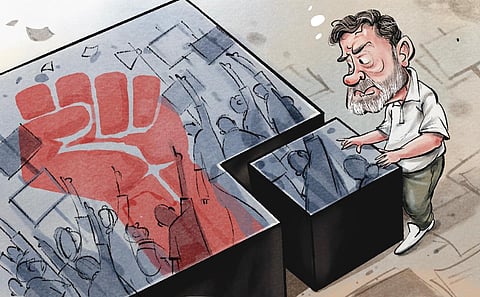

The summer and autumn of unparalleled protests by political and ‘non-political’ groups in Delhi, Mumbai, Prayagraj and elsewhere have the Union government over a barrel. Singly or collectively, the demonstrations and ambushes, once the hallmark of the BJP’s conduct when it was in the opposition, have demolished the myth of profound ‘Chanakya neeti sutras’ at work in the government’s moves.
The government’s only counter was predictable: the uninhibited use of police force without exception to name and fame. The Gandhi siblings and their compatriots, the Trinamool Congress’s dynamic MP Mahua Moitra, Gen Z’s icon and All India Students’ Association’s president Neha Bora and the youths who congregated for a second season of sit-ins at the national capital’s Jantar Mantar—everyone was quarry for the cops.
If pellet guns were not yet whipped out after their use in the July protests was excoriated, accusations of sexual violence surfaced. Young women and boys were allegedly pawed by the cops. Yet the protestors’ resolve to pressure the government until their demand for Chief Election Commissioner Gyanesh Kumar’s resignation was agreed to was beyond question. Every blow apparently sent a surge of adrenaline rushing through them.
However, it is a given that when one political party assumes (or self-assumes) the leadership of dissent against the government, differences are bound to arise both from the exigencies of a particular situation or the captaincy’s zeal to appropriate the stage front, left and centre, and allow associates a side role.
The INDIA bloc went into the protests as a supposedly cohesive front, because its constituents TMC and RJD took maximum hit from the Election Commission’s roll revision. The Samajwadi Party waits with bated breath as voter lists in Uttar Pradesh are vetted and scrubbed before next year’s Assembly polls.
The Congress stirred out of a semi-somnambulant state—its indifference to the mass deletions of electors in West Bengal was conspicuous—after the Cockroach Janta Party’s massive display of strength. The wake-up call could not have come a day too early.
The Gandhis reckoned that if they stayed aloof and allowed the roaches to crawl away with the limelight—although for public consumption, the CJP stays avowedly non-political—the Congress might as well acquiesce 2029 to the BJP. Rahul Gandhi and Priyanka Gandhi Vadra took the stewardship, and have since demonstrated they are second to none in staring down the cops and provoking retaliation, unmindful of being roughed up and detained indefinitely.
Indeed, the zeitgeist of Protests 2.0 was captured in the siblings’ surprise walk-in at the Akashvani Bhavan to court arrest under a tree, Rahul’s physical brush with the police and his ascent on the perilously-poised barricades, and Priyanka lying down with a copy of the Constitution in hand.
Meanwhile, the visceral hatred harboured over decades by the BJP towards the Gandhis spilled over.
But attractive optics alone does not ensure a turnaround in a party’s fortunes. Doubtless, by going upfront in their remonstrations, Rahul and Priyanka have charged up Congress workers. Rahul’s ‘Chhattron ki Goonj’ campaign in various cities attracted huge crowds and laid the ground for his defiance on the streets—something few expected from a person brought up on a “dynastic sense of entitlement”, as a political commentator remarked.
Rahul has discarded his fallibilities and stepped out as a battle-hardened politician. But he still cannot snap out of his ‘Ekla chalo’ stance, the overweening sense to go alone with just a few aides behind him and little patience to reach out to Sonia Gandhi’s peers, some of whom cannot be wished away despite their seniority.
It is an arduous endeavour to raise a team overnight in a party like the Congress. It is packed with competing ambitions and interests, often working at cross-purposes. Rahul’s colleagues had no idea that in July he had planned to lay siege to the PM’s residence, and this week they were clueless of the siblings’ detour to Akashvani Bhawan midway through the planned march to the Election Commission.
Where does this leave the INDIA bloc? On Wednesday, when Congress president Mallikarjun Kharge hosted a lunch for the coalition at an Udupi restaurant, the SP was unrepresented. The word from the Congress was there was a goof-up in messaging SP president Akhilesh Yadav, but a sub-text to the episode can’t be ignored.
The Congress’s organisational rejig in UP elevated its MP Imran Masood as the working president. Masood is a known SP baiter and has demanded a seat share which the SP believes is “disproportionate” to the Congress’s ground presence. The allies’ general sense was that the protests had transmuted into a Rahul-Priyanka project.
Trickier still is the Congress’s equation with the CJP and the broad Left alliance that has teamed up with the CJP to organise the October 10 protest at Jantar Mantar. Right now, the Congress does not even have a token relationship with the CJP. While the CJP founders flayed Rahul and Priyanka’s arrests, their “concern” was not acknowledged by the Congress, prompting independent observers to ask, had the CJP not taken on the government with its massive assemblage and suffered the police pushback, would the Congress have ever hit the streets on the EC’s omissions and commissions?
The government’s two-edged response to the simultaneous Delhi and Mumbai protests triggered endless theories, suggesting that while the political masters benignly let a huge gathering in Maharashtra’s capital to go on unhindered, the crackdown at Jantar Mantar was brutal. Was there a gameplan to divide the protests, covertly patronise the CJP and paint the Congress-helmed INDIA into a corner?
The CJP’s founders nipped such innuendoes before they gained currency. Abhijeet Dipke trained his words on Narendra Modi in his address at Shivaji Park, questioned the PM’s belabouring of his “chaiwallah” origin and asked why he did not educate himself instead. Dipke’s jab on the chaiwallah trope was not criticised like the one from Congressman Mani Shankar Aiyar years before had, signifying that the times have changed.
The CJP, SFI, AISA and the Association of Students for Alternative Politics (the Aam Aadmi Party’s student wing) together addressed a press conference on October 7 to signal that they would work as one for Saturday’s protest. Neha Bora emphasised that the coordination was based on issues—“a common agenda on common ground” were her words.
So the Congress will have to firm up its strategy—common agenda with INDIA constituents and perhaps the CJP, AAP and the Left, or get entangled in the leadership issue that presently has no relevance except to the Gandhis. It will be a consequential choice.
Radhika Ramaseshan | Columnist and political commentator
(Views are personal)
