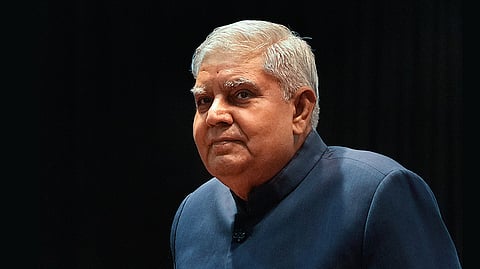

A return to history is painful for leaders used to making it. Vice President Jagdeep Dhankhar created history, but of a parliamentary kind dubious enough to earn him a membership of the government’s echo chamber. Hence, his premature resignation was a thunderclap cleaving India’s political skyline, creating a convulsion so fierce it shattered the BJP’s carefully curated narrative.
Cloaked in the polite fiction of “health concerns”, Dhankhar’s exit was anything but pharmacological. Once a formidable Jat strongman and one of Hindutva’s most zealous standard-bearers, he rose from Rajasthan’s feuding political plains to the gilded halls of Lutyens’ Delhi, brandishing his saffron credentials like a badge of honour. But somewhere between adulation and ambition, Dhankhar overstepped.
He undeservedly became the Vice President and shrank the chair he occupied. His tirades against the judiciary as “anti-national saboteurs”, and his rhetorical crucifixion of dissenters, once cheered by the Sangh parivar’s digital armies, began to chafe the very edifice that had elevated him. Behind closed doors, the party grew wary of his uncontrollable candour. When Prime Minister Narendra Modi finally broke his silence with a terse, curiously impersonal post on X that was more an epitaph than encomium, a flood of orchestrated condemnation burst forth. Sangh loyalists, ever attuned to the PM’s silences, took their cue. Knives, once sheathed, swiftly came out.
However, Dhankhar’s ignominious accidental exit has ignited the debate over BJP’s unwritten diktat that leaders must retire from active roles after age 75. Now, insiders believe that the rule has been selectively invoked to purge a few and promote many more with hardly any ideologically compatibility. Consequently, tried and tested Sangh veterans were denied an opportunity to serve either the party or the government.
This rule, first invoked with quiet firmness during the Modi-Shah consolidation of power in 2014, has since become a symbolic generational threshold that signals discipline and renewal. In a political culture long plagued by dynastic entrenchment and gerontocracy, the 75-year cut-off is a structural mechanism for leadership churn. Veterans like L K Advani and Murli Manohar Joshi were gracefully sidelined in favour of a new, more aggressive leadership template. In Dhankhar’s ouster, the party has an opportunity to reaffirm this ethos.
But the rule also serves a deeper ideological function. In an age where the opposition increasingly resembles a museum of political fossils clinging to relevance, BJP’s enforcement of internal retirement is a subtle but potent contrast. As the BJP navigates the choppy waters of coalition politics post-2024, with regional partners like the TDP and JD(U) demanding a more moderate stance, the reassertion of internal rules offers clarity and cohesion. The 75-rule may be informal, but its consequences are concrete. It is both a scalpel and a compass that trims dead wood while steering the party towards rejuvenation.
In this light, the Veep’s departure is a harbinger of systemic recalibration. Sagacious observers prognosticate a sweeping overhaul, from the party apparatus to governmental echelons. BJP’s 2024 electoral chastening, securing a mere 240 Lok Sabha seats, exposed vulnerabilities. Its reliance on NDA partners underscores a diluted hegemony. The RSS, emboldened by Mohan Bhagwat’s trenchant critique of BJP’s hubris, demands ideological rectitude.
Dhankhar’s fall epitomises the perils of elevating figures untethered from RSS moorings. The Sangh’s cadre recoiled at the precedent set by another Jat leader, Satya Pal Malik, whose apostasy discomfited the party. The RSS clamours for leaders steeped in its ethos, not mercurial opportunists. Dhankhar’s resignation galvanises this clarion call, exposing a chasm between the government’s centralised ethos and the cadre’s grassroots fervour.
Senior Sangh leaders feel appointments should done purely on merit and commitment. Along with a few others, hardcore swayam-sewak Rajnath Singh has emerged as one of the plausible VP candidates. If that’s the case, his ascension would necessitate a cabinet reshuffle, dislodging ministers entrenched for over five years. Many have faltered in actualising Modi’s ambitious reforms, from economic revitalisation to ‘one nation, one election’. A reinvigorated cabinet could infuse dynamism, aligning governance with Modi’s vision.
Concurrently, BJP’s organisational stasis demands redress. J P Nadda’s protracted tenure as president, extended beyond January 2024, has stymied renewal. A cabinet reshuffle could precipitate a new party president, ushering in a cadre of office-bearers unencumbered by inertia. The party’s second echelon, bereft of the charisma of yesteryears’ titans like Pramod Mahajan or Arun Jaitley, languishes in mediocrity. Defectors, ascendant in several states, dilute ideological fidelity.
The age conundrum looms ominously, too. RSS chief Mohan Bhagwat’s July 2025 exhortation that leaders retire at 75 reverberated through the Sangh parivar. Bhagwat, who will be 75 this September 11, and Modi, following on September 17, defy this precept. Their unparalleled efficacy renders them indispensable. But the cadre is uncomfortable with the inexplicable inconsistency in applying the age bar. According to them, while numerous experienced BJP and Sangh admirers have been ignored, Modi retains septuagenarian advisors and extends retiring civil servants’ tenures endlessly. Why, then, should Sangh stalwarts be marginalised?
The RSS champions meritocracy over chronological barriers. Hema Malini’s 2024 candidacy at 75 exemplifies this pragmatism. Seasoned ideologues, forged in the Sangh’s crucible, are vital to bridge the government-cadre divide. The BJP’s 2024 electoral setbacks, notably in Uttar Pradesh, underscored this disconnect. Voters rebuked the party for rolling out the red carpet for opportunists and party hoppers, signalling the need for leaders with ideological ballast.
The time for damage control is over. Now is the BJP’s moment of reckoning: do course correction or collapse. The Sangh is watching and it’s not amused. For too long, the BJP has placed loyalty above lineage, optics above ideology. Dhankhar rose fast, but he fell faster. Now, with a leadership reshuffle imminent, the BJP has one chance to restore ideological clarity. The cadre is demanding conviction, not convenience.
With the Congress-led INDIA bloc sitting on 234 seats, sensing momentum and smelling blood, the BJP cannot afford drift. Allies TDP and JD(U), being dependent on minority vote banks, will not walk the Hindutva talk and, instead, will edit it. The Sangh’s patience is finite. Modi’s visit to Nagpur in March 2025 was not symbolic; it was penitential. It was a tacit admission that the BJP, in chasing electoral dominance, has wandered off-script. It still dominates the electoral map, the bureaucracy, and cultural institutions. But power without purpose is a sign of decay.
The RSS is making it clear to the BJP that the next phase of saffron politics must be driven by conviction, discipline and doctrinal loyalty. This is where the cull begins. A dozen state elections stand between now and 2029. Modi needs warriors, not weathercocks. Yogi Adityanath and Devendra Fadnavis fit the mould. The rest must be sifted, sorted and cast aside. The BJP must now build a leadership that oozes saffron, not rented for convenience. The Sangh parivar’s mandate: ideological imposters will not be tolerated. Either the BJP returns to its core, or becomes just another party chasing power with no compass, no conviction, and eventually, a dim future.
Read all columns by Prabhu Chawla
Prabhu Chawla
prabhuchawla@newindianexpress.com
Follow him on X @PrabhuChawla
