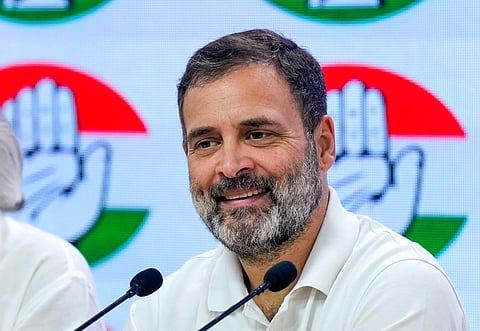

Consider the immeasurable width and breadth of the Shakespearean domain, and mixed metaphors are an inevitability. The Bard’s immortal allure lies in the universality of his work—hopefully, he will soon be taught in Hindi and other regional languages. “Savaal hai hoga ya nahi hoga”, when applied to Indian politics, begs the question of whether Rahul Gandhi will succeed like King Henry IV, who boasts in Act 1 Scene 1, “Yet herein will I imitate the sun, Who doth permit the base contagious clouds, To smother up his beauty from the world.” In the halcyon days of UPA I, Rahul, as a dimple-cheeked heir-in-waiting was Prince Hal, handsome and desirable: “Though I be but Prince of Wales, yet I am king of courtesy.” BJP’s troll tactics made him a social media Feste—“better a witty fool than a foolish wit,” or a Caliban in a remote island of self-pity: “As wicked dew as e’er my mother brushed. With raven’s feather from unwholesome fen. Drop on you both.
A southwest blow on you, And blister you all o’er.” Is Modi Prospero and the BJP Miranda then? Let’s not quibble, folks; anything is possible if your Thesaurus of Allegories is the works of ol’ Bill from Stratford-upon-Avon. Rahul’s disqualification by a maximised Gujarat magistrate became much ado about nothing, at least for now. Now, a tempest is gonna blow.
In 2019, Rahul became Hamlet, a doomed prince betrayed by his own impetuous destiny as the prince of an intrigue-infested and slavishly subversive court, namely the Congress. Sound-and-fury anchors predicted his political demise from war wounds inflicted by a combative Modi. But Pericles does return home, “Sir, in my heart there was a kind of fighting, That would not let me sleep.” Fight on, Sire, would have quipped the irrepressible Jairam Ramesh, his bantering buddy and communications chief, who has turned the Gandhi outfit’s once-decrepit digital delivery domain into the Zomato of Zeitgeist: “Though this be madness, yet there is the method in’t.”
Rahul’s method of resurrection was the Bharat Jodo Yatra: “Listen to many, speak to a few.” Listen he did, and spoke to a few truck drivers on a midnight run through Punjab. Lo and behold! Hamlet transitions into Harun al-Rashid, the nocturnal Caliph of Baghdad (I warned you this is a monsoon of mixed metaphors) who travelled about his domain in disguise to know the woes of his people. The Congress PR spin is about the little man against powerful giants—Rahul chatting with farmers in wholesale markets while Modi holds talks with world leaders. Or he is really, as King Henry IV mocked, “as the cuckoo is in June, Heard, not regarded”?
The overarching themes of Shakespeare’s work are love and loyalty (Merchant of Venice), ambition and treachery (King Lear), prejudice and jealousy (Othello): all in the pursuit of power, individual or royal. These are the immutable characteristics of the human race; which is why they will forever be relevant as long as the last human walks the earth. In the end, arrive retribution and redemption at great cost (Macbeth). Hal vs Hotspur or Rahul vs Modi is just repeating tropes that mirror fiction and life. The true nature of politics is reflected in Banquo’s question, “What! Can the devil speak true?” The answer lies in Hamlet, of course. “One may smile, and smile, and be a villain; at least I’m sure it may be so in Denmark.” And something indeed was rotten there.
Ravi Shankar
ravi@newindianexpress.com