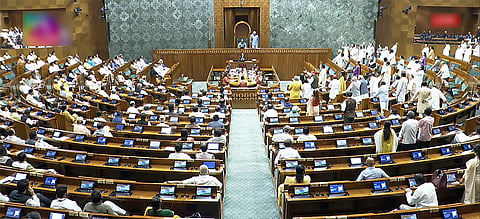

In a rare exhibition of consensus, the opposition parties and the ruling alliance have deemed the monsoon session of parliament a washout. The trigger for a parade of adjournments was the scandalous handling of the revision of electoral rolls. Who can vote, what defines citizenship, who decides who is a citizen and more. There are questions galore in this classic Indian conundrum and the Election Commission has covered itself with infamy.
Chaos unravelled in parliament while the issue is in the Supreme Court. Typically, the elected MPs end up representing their parties, not those who elect them. The cost of the washout—estimated at Rs 2 lakh a minute—is important. More critical is the price paid in failing oversight on legislation and governance. The circumstance merits a review of governance on issues that affect lives and livelihoods. Here are a few snapshots.
Like the big challenge before India is the threat of unilateral tariffs imposed by the Trump administration. The statement on their potential impact was lost in a din of rhetoric. The issue sparked seven questions in the Lok Sabha and 13 in the Rajya Sabha. Ideally, the issue should have catalysed a debate, even an all-party select committee on strategies. That was not to be.
Be that as it may, the government has rightly focused on issues haunting the domestic economy and created two iGoMs (informal groups of ministers) for economic and social sector reforms. The two panels are tasked with laying out legislative and policy reform agendas. While this is welcome, it raises questions about the declarations of measures made in Budget 2025.
In February, the Budget announced the creation of a high-level committee for regulatory reforms to review the landscape of what is, effectively, a permission raj. It is well recognised that business is daunted by regulatory burdens. A study by Avantis Regtech shows entrepreneurs face 1,500 laws and over 69,000 compliances. Did MPs query the government? Fact: there are two committees on the job and their first meetings were held on August 21.
A bulk of the much-needed reforms is pending in the states. The Investment Friendliness Index of States—announced in February to spur change—awaits launch by Niti Aayog. A fund for boosting innovation and research in the private sector was announced in July 2024; its budget allocation of Rs 20,000 crore for this year is yet to see disbursals.
The 2024 budget declared ‘cities as growth hubs’. This led to the creation of an ‘Urban Challenge Fund’ in February 2025 with an allocation of Rs1 lakh crore in this budget. Did MPs query the status? Meanwhile, floods continue to terrorise towns and cities. As early as in 2021, a report of the ministry of housing and urban affairs revealed that construction on floodplains had made cities vulnerable. In August 2025, a parliamentary standing committee was told that guidelines on floodplain zoning drafted in 2024 are “pending with states for their inputs”.
Quality of life and habitat determine investments and reinvestments. The fact is net foreign direct investment into the country—inflows minus outflows of repatriation and investments by Indian companies—fell sharply to $400 million, as against $10 billion last year, even though gross FDI was at $80 billion. The data should have catalysed debate on the reasons and corrections to the production-linked incentive scheme, and woo investments whether the China+1 model is alive or not.
One of the successes of this regime has been the opening up of defence production to the private sector. Operation Sindoor validated this. That said, the system is wracked by issues. Consider this nugget: the government issued 43 licences to manufacture bullet-proof body protectors. The parliamentary standing committee on defence has discovered that 33 of these companies have not commenced production! Knowing why is critical to the quest of atmanirbhar defence.
Investment in higher education expands capacity and propels innovation; it needs boosting faculty strength. Fact: hundreds of posts are lying vacant across institutes focused on scientific research. Over 700 posts, including of scientists, are vacant at the Satish Dhawan Space Centre. Over 2,500 posts are vacant across 23 AIIMS centres and over 2,200 posts are vacant at bodies under the Ayush ministry. At the primary education level, a total of 7,765 teacher posts in Kendriya Vidyalayas and 4,323 in Navodaya Vidyalayas are vacant.
Like its known investors are troubled by delays in redress of legal issues. On August 1, the government revealed data on pendency of cases—86,844 in the Supreme Court, 63.32 lakh in high courts and 4.66 crore in subordinate courts. Pendency is a much-studied subject and one major cause is vacancies —334 judge posts in high courts and one in five posts in lower courts are vacant.
The promise of the Insolvency and Bankruptcy Code is stranded—there are 14,961 cases pending at the National Company Law Tribunal. Tax disputes are constant punctuations in conversations at investment conferences, The total tax arrears pending as on June 2025 under indirect taxes was Rs 7.01 lakh crore and under direct taxes Rs 47.5 lakh crore. There are over 6.11 lakh cases with Rs 31 lakh crore demands pending litigation under income tax and over 97,400 cases and Rs 3.71 lakh crore under indirect taxes.
India’s governance and potential are hostage to the short-termism of petty partisan politics. And no party can claim innocence amid this cacophony of unanswered questions.
Read all columns by Shankkar Aiyar
Shankkar Aiyar
Author of The Gated Republic, Aadhaar: A Biometric History of India’s 12 Digit Revolution, and Accidental India
(shankkar.aiyar@gmail.com)
