
There is a new term for volatile uncertainty in the post-Davos world. It is spelt TRUMP. Economic security matters—more so when whims are weaponised, super imperialism arrives dressed in past and imagined grievances and a US president levies tariffs because his claim of brokering peace is not validated. The rules-based world order—always a cartel of the West—a convenient, useful fiction in the best of times, stands exposed. Even this very flawed model is, to paraphrase Canadian Prime Minister Mark Carney, facing a rupture.
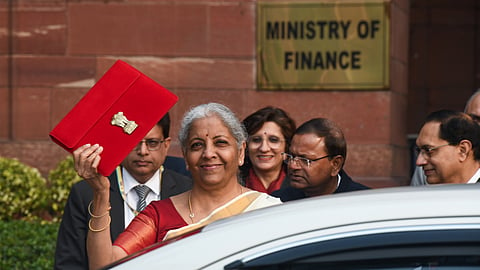
Context matters for politics and economic policy. Next Sunday, Finance Minister Nirmala Sitharaman will present the 2026 Budget in one of the most challenging global and domestic settings. It is true that India is likely to end the year with 7.4 percent GDP growth.
However, there is no disputing the distress in employment-intensive sectors and sustainability following the advent of artificial intelligence-enabled commerce.
The data illustrates the fault lines. The rupee has fallen from 86 per dollar to over 91.95 in a year. Net foreign direct investment is down. Sell-off by foreign institutional investors—Rs 29,000 crore this month—pushes the rupee down and the falling rupee triggers further sell-off. Private consumption is verily K-shaped.
IT services is the largest formal employer and consumption accelerator. India’s top five IT companies added just 17 net employees in the first nine months of 2025-26. Home sales are down 14 percent in major metros. Houses priced below Rs 75 lakh, which constituted 60 percent of sales, are now at 32 percent, while those priced above Rs 40 crore jumped 66 percent in 2025.
India must find answers for its economic security within its potential. Budget 2026 must Trump-proof India’s economy by eliminating friction, enhancing entrepreneurship and improving income generation for propelling consumption among 140 crore people. Here are a few observations and exploration of possibilities for ramping up investment, employment and growth.
REVIVE THE RUPEE: The decline in the rupee is both a cause and consequence of events. The circumstance calls for steps beyond foreign-currency non-resident account band-aids and policies for export promotion and import substitution.
Restoration of value demands the creation of investment opportunities to draw in dollars. Blend the intent for privatisation with the need for FDI. India should invite global bids for public sector assets—government holdings in banks, in state-owned airports, in oil retailers. It should also create plug-and-play sites using idle space in sick PSUs like HAL in Pune or MTNL for data and capability centres to capitalise on the AI rush.
INDIA INVESTMENT SUMMIT: Davos 2025 featured surreal theatre—seven Indian chief ministers flew to Switzerland so Indian companies could meet them to discuss investing in India.
Instead, why not invite investors to India? To start with, the CMs could share their experience—what investors want. CMs can be invited to showcase what they can offer and add Niti Aayog’s much-promised Investor Friendliness Index. The crux is, instead of every state holding their own event—like Kinetic Karnataka or Magnetic Maharashtra—why not host an India Investment Summit for opportunities across India?
BUILD NEW CITIES: Urbanisation is an acknowledged multiplier of growth. Indian cities will host nearly 90 crore people by 2050. We need more cities, homes and better living spaces. Yet India, as per the World Bank, spends less than 1 percent of its GDP on urban infrastructure. PSUs possess over 18 lakh acres of land. Hawking them piecemeal has not worked as the National Land Monetisation Corporation, created in 2022, has struggled. Instead, bundle PSU land with adjacent ordnance, railway and defence parcels to create integrated townships—not the next Mumbai or Chennai, but smaller ones hosting less than 10 lakh people. These could also be senior retirement homes. Open them for global bids to drive investment, jobs, consumption and growth.
CREATE INDRA: India needs a platform—India Development Research Agency—to host technologies to meet challenges old and new. Institutions such as DRDO, Isro, NCL, ICAR and others designed solutions, but struggled to monetise them. Isro can map soil moisture and help predict yields. DRDO has expertise in phase-change materials that can trim cooling costs. The National Chemical Laboratory has looked at biodegradable polymers. The 2024 Budget initiated the creation of a Rs 1-lakh-crore Research, Development & Innovation Fund and a Rs 1-lakh-crore Urban Challenges Fund was proposed in 2025. The ideas are still on the runway. Why not create INDRA, à la the US’s DARPA, to create an ecosystem to foster solutions and monetise them on a fee-royalty basis to solve India’s problems.
REGULATORY REFORMS: Every square mile of India is governed by states, who control standards and permits in critical areas. Budget 2025 promised regulatory reforms—both at the Centre and the states. The government informed parliament that two high-level committees were working on such reforms. What is the approach? For instance, a power project needs 116 approvals. Must this be so? Why not do a flow chart of permissions? Is the system being interrogated? It will be useful to have an interim report and a deadline for the final report.
India, unlike other middle powers, is not fully tethered to blocs defined by identity or ideology. Yet, it is haunted by a lack of capacity to translate ideas into outcomes, and its politics frequently waits for a crisis before acting. Budget 2026 presents an opportunity to break this pattern. It can empower the economy, unleash the scale of its domestic market and entrepreneurial potential, and address structural fault lines. This Budget can Trump-proof the economy.
Read all columns by Shankkar Aiyar
Shankkar aiyar
Author of The Gated Republic, Aadhaar: A Biometric History of India’s 12 Digit Revolution, and Accidental India
(shankkar.aiyar@gmail.com)
