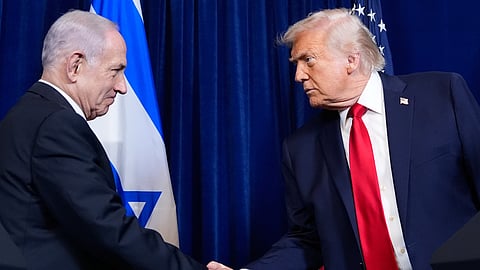

The war in West Asia—waged by the US and Israel over Iran—entered the second week on Saturday. In these seven days, Operation Epic Fury has dragged over a dozen countries into the theatre of conflict, grounded thousands of flights, and blocked shipment of oil and goods. It has sent crude oil prices to over $92 a barrel, gold to over $5,300 and sent stocks into a rabbit hole of anxiety.
The US describes it as “military operations” and not yet a “war”, even though it has put millions of lives at risk, busted the supply chain of goods and energy, and left people in and outside the theatre anxiously watching the news streaming from the Persian Gulf. It bears mention that Russia’s war on Ukraine—now in its fifth year—was tagged as a ‘special military operation’.
The conflict is dubbed War-a-Lago since it was launched from Trump’s nest Mar-a-Lago, just like the operation on Venezuela was. Trump’s War-a-Lago style claims adherence to broader America First geopolitics. It is fuelled by personalisation of politics, politicisation of faith and it is amplifying global instability. The journey from illusion to delusion is eloquently explained by Lord Varys in The Game of Thrones: “Power is a curious thing. It’s a trick on the wall. A very small man can cast a very large shadow."
As the world heads towards the Ides of March, it is yet to be informed about the rationale for the war. Yes, there is speculation about Epstein files, echoes of Wag the Dog and other theories. Beyond the speculation: why, and why now? Team Trump has blathered around the question. Trump said Iran planned to attack while it was in talks. Secretary Marco Rubio admitted Israel planned a strike, but the US couldn’t stop it. So, a pre-emptive strike then. By the end of the week the ‘why’ was about Iran’s nuclear programme and ballistic missiles. That’s curious since, in June 2025, Trump claimed that Iran’s nuclear sites had been obliterated.
Now that we have the why out of the way, let’s look at what the objective is. Trump posted, “There will be no deal with Iran except UNCONDITIONAL SURRENDER!” And that Trump will choose the leader. Iran said it was no longer looking to negotiate. The standoff could end in one of three scenarios—total surrender, continuation of regime in Venezuela model, and total chaos. The only concession Iran has offered is not to target neighbours. Trump is yet to find a Delcy Rodriguez in Iran. The spectre of chaos—in a nation of 90 million aggrieved people torn asunder—haunts the Gulf Cooperation Council nations.
History is replete with instances of nations led by leaders intoxicated with hubris diving into disasters. In the 1800s, after invading Portugal, Napoleon decided to conquer Spain. The Spanish collaborated with guerrillas and British forces and tied down the French army all the way till 1814. Napoleon dubbed the campaign ‘the Spanish ulcer’ from which he never healed.
Hubris trips regimes in modern times too. The regime change of 1953—orchestrated by the US and the UK—had virtually failed before it was propped by CIA operative Kermit Roosevelt Jr. Roosevelt bribed the Iranian resistance to install the Shah. Every attempt by the US since World War II has ended badly—in Iraq, Syria, Libya and Afghanistan, where it replaced the Taliban with the Taliban.
The irony is that a victory is a necessary condition for the US and Israel. As for Iran, to borrow a football term, even a draw is a victory. The US clearly underestimated the response of Iran. In its response, it stands accused of slaying civilians—the death of over 160 schoolchildren killed in Minab is a tragedy of epic proportions.
For decades, the US has preached the power of example over the example of power. The Trump administration has binned the construct of example and established the suzerainty of power. On Thursday, the deputy secretary of state warned that the US would not repeat the mistake it did with China. On Friday, the treasury secretary said the US was “permitting” India to buy Russian oil. On Saturday, the energy secretary said the US was “allowing our friends” to buy Russian oil. The embedded hierarchy of language stinks as it reflects expectations of subordination.
In its conduct of war, the US has—in its actions, words and silence when it should have spoken—shredded rules it co-authored, protocols it expects of others, and decencies anticipated. The targeting of Iranian frigate IRIS Dena—returning from an international review in India, torpedoed by a submarine clearly lurking in the region—is an illustration of superpower arrogance. It didn’t matter that the ship was way off the war theatre, that it was a guest of India in India’s sphere.
Trump came to power promising an end to forever wars. Earlier this week, he met CEOs of arms makers, promised the US would do whatever it took and even spoke about boots on the ground. As millions of gallons of JP-8 jet fuel are burnt in the air strikes, gasoline prices are rising at the pump. The throttle over Hormuz Strait blocks not just oil and gas, but regular shipments. Inflation, sadly, cannot be knocked down by missiles.
The world is worried. Such is the state of angst that folks are referencing the views of oracles, among them Prof Jiang Xueqin, who predicted that the US would lose the war. Channels in India are pitting the professor's views with astrologers’ and those in Israel with the Kabbalah. Trump’s War-a-Lago has left people trapped on the Ides of March.
Read all columns by Shankkar Aiyar
Shankkar Aiyar
Author of The Gated Republic, Aadhaar: A Biometric History of India’s 12 Digit Revolution, and Accidental India
(shankkar.aiyar@gmail.com)
