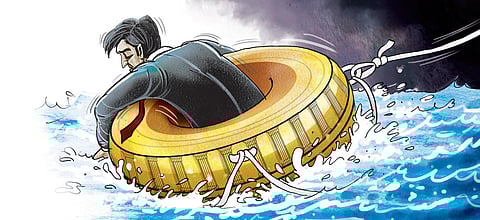

Recently, a cartoon strip carried a caricature of a small shop with a number of “Going out of business” signs hanging outside the shop. “Things must be tough,” consoled a passerby. “Nope,” replied the owner, “Business is booming—we just make the signs.” That business may be booming, but the 65 million small businesses of India that have been left high and dry due to the lockdown are not.
These businesses are the lifeline of the country as they give livelihood via low-skilled jobs to 100 million workers, produce 45% of India’s manufacturing output and contribute to 29% of the nation’s GDP. The current crisis has left them devastated. The banks, their primary lifeline, have shut the cashier window on them as they are focussed on recovery of past bad debt and have become cautious as they anticipate a slew of defaults on personal, credit card and vehicle loans due to extended lockdown. The central bank has been trying old tricks of lowering interest rates to disincentivise banks from parking funds with them, but the banks have lost the appetite to take any risks. NBFCs, another avenue for small businesses to borrow, are also of limited help as they grapple with liquidity challenges due to the recent history of high-profile defaults.
To alleviate the woes of small businesses, there is a growing lobby asking for a bazooka package like that being done in the US. We definitely need a package, but we must be cognisant that India’s fiscal limitations do not allow for an exuberant bailout. There is a reason why our headline bailout package was for just Rs 1.7 trillion, a meagre 1% of our GDP. India will have to do more with less and judiciously use the resources. It may mean that some of the businesses do not make it to the finish line, but the fact is that irrespective of the size of the bailout there will be some businesses that will go down under. Despite having a $2 trillion coronavirus rescue package, 100 times the size of India’s package, there are many US businesses that have shut shops and as a result, 26.5 million American workers have filed unemployment claims. Hence, the need of the hour becomes to identify these small critical businesses that can influence the economy and livelihoods at scale.
For instance, the government can seek involvement of fintech companies that can help identify the health of businesses through a stack of customer data and ensure stimulus is rapidly distributed. The US and UK have roped in fintech companies to disburse stimulus packages as they are the closest to the small businesses and have visibility on their cash flows. As shadow banks shy away from lending, RBI should also think of a model where the extra liquidity in the system can be passed to small businesses via fintech companies. If it works, small businesses could be exclusively served by these new breed of companies in future while the big-ticket corporate houses can be served by commercial banks, thereby renewing their focus and ensuring non-performing assets can be tracked early.
As resources are limited and there will be many firms that will not receive any help, businesses should do what they do best—jugaad. Even if the lockdown fully ends tomorrow, these businesses will not be functioning at full capacity for another six months or so as the international supply chains may still be broken, labour may not return immediately or the end consumer of exports may still be under lockdown. This calls for large-scale asset sharing between these businesses. A garment exporter may lend their factory to another business unable to meet the high demand for personal protection gear or a chemical factory owner may sublet to a specialised bleach manufacturer. The government should proactively enable this exchange and ensure businesses don’t just endlessly wait for a ‘big’ package. Even if the bailout is small, the government can fast-track the implementation of the invoice-discounting-platform as announced in the Budget. A low-cost platform can enable businesses to get advance payment for outstanding invoices at a discount from third parties willing to undertake the risk. In a normal scenario, businesses have to wait for 30-45 days for payments but due to the extended lockdown, the wait has doubled.
The government and big business together owe these small businesses nearly Rs 6 trillion! While we should do more with less, the miseries of small businesses should also be fixed structurally. These businesses are ostracised from the credit market; the equity market is out of reach and also less desirable as it entails giving up ownership of the company. It has been said ad infinitum but the government should consider creating a special bond platform for these businesses so they can borrow with dignity.
With exposure to bond markets, businesses will aspire for a better financial standing as it improves their bond ratings and has implications on the interest payout from the business owner to the bondholder. To enable better financial standing, businesses will aim to upskill their workers, follow labour codes, enable digitisation and, more importantly, come under the ambit of tax base.Fighting a crisis can be a dirty business, more so a one that has no precedent. Apart from resilience, it requires compromise and flexibility. We need to do more with less and try to save as many businesses as possible.
Abhimanyu Girotra
Management graduate from IIM-Calcutta and freelance writer
(Views are personal.Email: abhimanyug@google.com)