
A constitutional court attains significance on account of its counter-majoritarian role in a democracy. Judicial review is a process against legislative mischiefs and executive onslaught. When personal liberty is in peril, the trial court also exercises a constitutional function. Article 21 of the Constitution protects liberty of every person, which should not be deprived of “except according to procedure established by law”. Article 22 grants “protection against arrest and detention in certain cases”. The constitutional text, which on the face of it is impressive, requires a conscious effort from the judiciary to materialise. Unfortunately, this is an area where Indian courts have often failed. During the last decade, the country had to pay a heavy cost for this failure, in terms of democracy and freedom.
Yet, a series of consolatory orders issued recently by the Supreme Court are significant. By way of an extraordinary order, the court granted interim bail to the Delhi Chief Minister Arvind Kejriwal. In another case, it invalidated the arrest of journalist Prabir Purkayastha and directed his release. In yet another development, the court ordered the release of Gautam Navlakha, a great intellectual of our times, an accused in the Bhima Koregaon case. Again, a bench headed by Justice Abhay Oka made an important declaration that the Enforcement Directorate cannot arrest an accused once the special court has taken cognisance of the complaint of money laundering.
In some of these cases, the court was correcting lower courts while in others, it was correcting itself. The interim bail in Kejriwal’s case raises many questions on its reasoning, precedential validity, and impact on the cases of Manish Sisodia, Hemant Soren, etc., who faced a similar predicament. The Criminal Procedure Code does not contemplate the idea of interim bail. But the power of the Supreme Court to grant an interim bail could be justified by Article 142 of the Constitution, according to which the court can, in the facts and circumstances of a given case, pass any order to provide “complete justice”. Yet, in Kejriwal’s case, with a direction to get back to the prison in a foisted case, justice rendered was clearly incomplete.

Kejriwal’s plea was not for interim bail or even regular bail. He complained that the very arrest was illegal. The basic contention was the arrest was in breach of Section 19 of the Prevention of Money Laundering Act (PMLA). The arrest based on a statement was made under dubious circumstances and therefore was invalid, he contended. Even the singular statement where Kejriwal was named was not corroborated. The long delay between the incriminating statement and the arrest was also highlighted by Kejriwal’s counsel. The approver’s statement should not be the basis for arrest, it was argued. With such a strong case against the arrest, it would have been more plausible for the court to stay the order of arrest and remand of the chief minister or invalidate such acts, which would have freed him without a deadline, as now happened. However, even the present order may provide him some respite.
In Gautam Navlakha’s case, however, the court was correcting itself by vacating the stay on the bail that the Bombay High Court granted. The court noted that the trial might take several years to conclude and detaining him till then would be unfair. Let it not be forgotten that there are reports that try to establish that the significant part of the “evidence” in the Bhima Koregaon case was implanted into the computer devices to book the accused.
Now that Navlakha has come out of prison, his notes reflect the realities, attitudes and apathies of the regime. His release is a solace for himself and those who believe in the universality of human rights and the intrinsic value of freedom. Yet with the same belief, one looks at the fate of a few other accused in the same case who are still in prison, who could not be rescued by the court. With the same belief, one remembers the death of Stan Swamy, whose martyrdom while in judicial custody smashed all the tall talk about India’s democracy. Also, one looks at the long period of incarceration of the accused now released.
In Prabir Purkayastha vs State, the release of the journalist was done based on a realistic application of Article 22 of the Constitution. The judgement said the accused must be provided with the written grounds of arrest as per Section 19(1) of the PMLA. The court said Section 43B of the Unlawful Activities (Prevention) Act (UAPA) is in pari materia with Section 19 of the PMLA. In an earlier judgement in Pankaj Bansal vs Union of India (2023), the court held that the grounds of arrest under PMLA was to be given in writing to the accused. The same principle should be applied in UAPA cases as well, said the court for Prabir Purkayastha. The court relied on the classic judgement in Harikisan vs State of Maharashtra (1962) to say that the accused is entitled to know on what grounds he is arrested. In Purkayastha, the court found the due process of law was sabotaged by clandestine methods as it was only after the remand that the grounds for the arrest were communicated. It was clearly a case of misuse of law and abuse of process.
In all these cases, the respective accused have undergone a long period of incarceration that apparently was not legally or legitimately due to them. The bigger tragedy is that even these accused form only a minuscule portion of those who were arrested and detained under various provisions of law during the last decade. Many of them remain in oblivion.
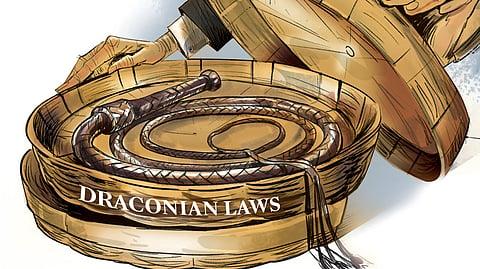
About 76 percent of prisoners in India are undertrials, out of which a good part may be considered ‘political prisoners’. They were often the victims of draconian laws like the UAPA and PMLA. Many of the arrests and detentions would call for immediate judicial interventions, which again, the Supreme Court can do under Article 142 of the Constitution. Also, we need a mechanism to probe into the political design behind such entrapments and compensate the victims of an illiberal dispensation, for which a Truth Commission should be formed. It should be the first task that a democratic government should undertake after June 4.
Kaleeswaram Raj
Lawyer, Supreme Court of India
(Views are personal)
(kaleeswaramraj@gmail.com)