
When India won freedom in 1947, some of the finest and most far-sighted ideas in the realm of anti-colonial thought lost out in the struggle for power at the helm of the post-colonial state. Foremost among these was the imperative of power-sharing arrangements between the federal centre and the constituent units. Partition, with its religious connotation, obfuscated the provincial political dynamics that had made imaginative ideas of a federation such an irresistible goal for a cross-section of anti-colonial nationalists. We need to engage in a creative process of historical retrieval of visions for substantive democracy and federal union during the struggle for freedom that remained unrealised during the post-colonial transition.
On June 26, leaders of the Rashtriya Swayamsevak Sangh suggested considering removal of the terms ‘secular’ and ‘socialist’ from the preamble of the Indian Constitution. These two words had been inserted as part of the 42nd Amendment railroaded through parliament during the authoritarian interregnum of the Emergency. The erasure of ‘secular’ would be a symbolic victory for the proponents of a Hindu republic and consigning ‘socialist’ to the dustbin of history would be appropriate in an era that brazenly revels in increasing socio-economic inequality.
Both secularism and socialism had been adduced by Indira Gandhi as ideological pillars of centralised state authority. As these columns have cracked and crumbled in formally democratic India, religious majoritarianism has been harnessed in the service of centralised authoritarianism.
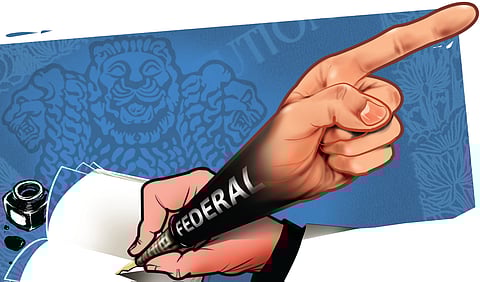
If symbolism in the preamble matters, it may be much wiser to add a word rather than subtracting two. On November 15, 1948, K T Shah had brought an amendment to Article 1 to proclaim: “India shall be a secular, federal, socialist union of states.” The preamble was not up for debate at that stage of the proceedings, hence Shah wanted to bring clarity by amending the first article. “Lest the term ‘union’ should lead anyone to imagine that it is a unitary government,” Shah stated, “I should like to make it clear, in the very first article, the first clause of that article, that it is a ‘federal union’.”
B R Ambedkar made two objections. First, he claimed that the Constitution was “merely a mechanism for the purpose of regulating the various organs of the State” and “what should be the policy of the State, how the society should be organised... cannot be laid down in the Constitution itself”. Second, he regarded Shah’s amendment to be “superfluous” so far as the term ‘socialist’ was concerned, but said nothing about ‘secular’ and ‘federal’. He claimed that if the directive principles in the Constitution were “not socialistic in their direction and their content, I fail to understand what more socialism can be”.
After Shah’s sage suggestion to include the word ‘federal’ was rejected, Mahboob Ali Baig wondered if “the framers of the draft Constitution had in the back of their minds a unitary government and yet called it federal... If you mean that the government must be a federal government and not a unitary government, and if you want to prevent in future any power-seeking party to convert it into a unitary form of government and become fascist and totalitarian, then it is up to us now to use the correct word, which is federation”. This amendment, too, was negated.
Shah was nothing if not persistent. He brought another amendment to Clause 1 of Article 1, adding the words “equal inter se” after the word “states”, and used that opportunity to rebut the points Ambedkar had made. It was “something new” for him to hear that the Constitution was “a mechanism for regulating the various organs of government” and that “any desire to include in it any aspiration of the people might be regarded as somewhat out of place”.
As for the directive principles, these were in Shah’s opinion “the vaguest, loosest, thickest smoke-screen that could be drawn against the eyes of the people... If this union is to be a true federation, as we are assured it is going to be... then I suggest that it is of the utmost importance that the constituent parts of the union should be and must be equal amongst themselves”. H V Kamath supported this amendment, but it suffered the same negative fate as the others. Elsewhere, Shah also wanted to categorically deny the centre any authority to change the name and boundary of any state without the explicit permission of the state legislature.
Subhas Chandra Bose had invited Shah to join the National Planning Committee alongside Radhakamal Mukherjee and Meghnad Saha—all three of them being confirmed federalists. Shah worked closely with both Bose and Jawaharlal Nehru during the freedom struggle. He parted ways with Nehru along with other socialists like Saha when the first Indian prime minister appeared to prefer post-colonial continuity to a radical departure from the colonial past.
Shah lost as an independent to a far less distinguished candidate belonging to the Indian National Congress in the first general elections, as did Ambedkar, who had come to a temporary accommodation with the Congress leadership during the Constitution-making process.
Shah ran as the independent opposition candidate in the first presidential election in 1952 against Rajendra Prasad, the Congress nominee who had presided over the Constituent Assembly. Saha, his friend and colleague from their National Planning Committee days, and now a socialist and federalist member of parliament from Bengal, had persuaded him to run. He lost despite being truer to the principles of the anti-colonial struggle than the victor. He observed, “We in India talk of real democracy, and yet so effectively centralise the real power, authority and resources of government as to make of provincial autonomy, or municipal and village self-government a tragic farce.”
The words of the preamble are indeed beautiful and inspirational, and the addition of the word ‘federal’ would further embellish it. It is not just a matter of semantics: federalism also needs to be implemented substantively. As India awaits a fresh census and a delimitation of parliamentary constituencies that threatens to undermine the political weight of the southern states vis-à-vis the Hindi-speaking north, the question of federalism must be addressed, not evaded. A strong Indian union can only be of the federal type.
In addition to the alienation in Kashmir and the Northeast, the recrudescence of Tamil, Kannada, Marathi and Bengali pride is a portent of the future direction of politics. The most far-sighted political thinkers and leaders of our freedom struggle did not believe either in inheriting a colonial centralised state or in narrow provincialism, but rather an imaginative and generous federal union. An honest intellectual reckoning with the loss of that grand vision at the founding moment of our republic is a necessary precondition for advancing the cause of democracy and federalism against centralised authoritarianism.
Sugata Bose | Gardiner Professor of History, Harvard University
(Views are personal)