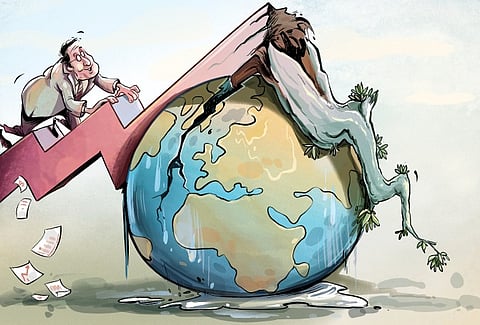

The big problem with information today is not noise, but silence. The latter is the most eloquent part of a lecture. Yet, one never asks about the kind of violence that precedes every part of a story.
My next-door neighbour, a sociologist, recently commented, “Why is everyone talking about development when they should be talking about the Anthropocene? Silence needs a new kind of storytelling.” It reminded me about a Pakistani social scientist who talked at length about a conference.
I once met Ziauddin Sardar, the well-known futurist, at Perth airport. We had three hours to kill. He was returning from a conference, and I from visiting relatives. Zia was a wonderful gossip and even more entertaining as a social scientist. He was a genuine South Asian. He wrote the most interesting article on the Ambassador car—I wish Ratan Tata had read it before he introduced the Nano.
On this day in Perth, Zia was waiting to gossip—not just about the conference, but about his old colleagues and friends in India. He felt gossip was disappearing. And gossip, he felt, made eccentricity and dissent available. This is what he felt made India of the 1970s so interesting. Zia desperately missed his colleagues at the Centre for the Study of Developing Societies. India, he felt, had become rigid and straightforward. He felt that the present regime had added to the mediocrity, destroying India’s sense of play and dissent.
I asked Zia about the changes. He sat silently for a while, drinking his coffee. Then he said that today, the future is an extrapolation, regimented into a straight line of expectations. Earlier, the future was a domain of dissent and diversity. The future is a pretext for freedom—an invitation to the Homo ludens, the human as a player. Zia explained that earlier, such conferences were full of oddballs, marginals who ambushed you with new ideas. The future was open-ended and inclusive. Over the next three hours, he proceeded to describe the three-day conference he had been part of.
The first day was a meeting of knowledge and power, demonstrating the competence of policy. There was only one interesting paper, from South Africa. It talked about Islam in general and believed that India could add a new kind of Islamic imagination to the future.
The second day focused on the basic theme of the conference: the Anthropocene. The word ‘Anthropocene’ was coined by Dutch scientist Paul J Crutzen. He believed it’s a new geological era during which human activity has been the dominant influence on climate and the environment. Crutzen wanted to create the picture of a wounded Earth—damaged by a promethean man. The Anthropocene was a statement of guilt.
Unfortunately, the debate got involved in dates. Dutch scientist Wiebe Bijker felt that assigning dates to the era had become an obsession. The question was whether to date the Anthropocene to the beginning of the Spanish conquest, which eliminated a million indigenous people, or to locate it at the Industrial Revolution. Today, many prefer to locate it with the birth of the atom bomb.
Zia said, regardless of the dates, what the dating did was remove the question of guilt—the fact that Earth was being destroyed by man. He added that two earlier papers that had discussed the Anthropocene were purely economic exercises, where climate change became a battle between the centre and the periphery.
But the next paper ambushed the conference. It was by a shaman serving as a lecturer at a local university. The shaman’s speech was electric, as if it was an afterthought brought into the conference. He said that what futurology lacked was the quality of storytelling, the ability to create a new myth for the Anthropocene.
The Western idea of Anthropocene was an incomplete myth—it talked of Prometheus, but it had no sense of an alternative. The myth one needed to destroy was the idea of economics, which is centred around the ‘noise’ called consumption. Zia said it’s economics as a myth that upholds the West, which gives it a sense of the sacred, as being the centre.
Ideas like sustainability are poor substitutes for myth-making. You need to question the very sense of the 18th-century economist, Adam Smith, and locate genocide at the very beginning of economics. The shaman added that this process was politely called ‘development’. Development needed to be retold, and for that, maybe his colleagues could read Austrian philosopher Ivan Illich. He added that to question development was to rewrite the very history of the West.
Myths, said the shaman, had to make us relive and rethink to create a new sacrament that would make us retell the story of the forest as a sea. The Anthropocene, the shaman noted with sadness, lacked the poetics of rethinking. It was a myth that needed to be relived—but not through the obscenity of climate change, which was merely a cost-benefit analysis.
Earth had to come to life. Science had to acquire a sense of the sacred. One needed a new kind of storytelling, new rituals to redeem Earth. The West, the shaman quietly said, had no language for it. Enlightenment was a poverty-stricken philosophy that had no empathy for the sky or the tree.
The shaman spoke quietly, but effectively. The West, he said, was smothered in formaldehyde. One needed to begin with a prayer, an invocation of new cosmologies and new epistemologies, a new sense of ethics for the West and the rest. The conference came to a halt.
Zia chuckled as he recited the story. The shaman, who called for storytellers more than statisticians, challenged the conference to think of the forest as an epistemology—of a tree as the cosmos.
The airport announcements were reminding us that time was running out. Zia and I agreed to meet next year. I suddenly asked him: what happened to the shaman? Zia smiled and said he disappeared into his community after the conference.
Zia left to catch his flight and I moved on to tell the story to as many of my colleagues as possible.
Shiv Visvanathan | Social scientist associated with the Compost Heap, a group researching alternative imaginations
(Views are personal)
(svcsds@gmail.com)
