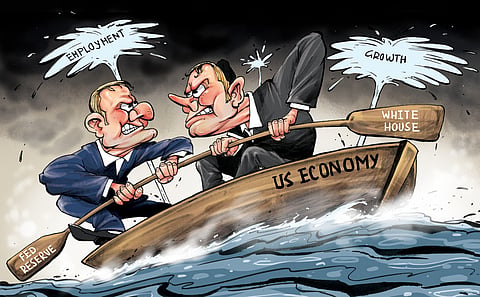

The spat between the White House and Fed Reserve Chairperson Jerome Powell, an appointee of US President Donald Trump, is hardly unusual. Lyndon Johnson and Richard Nixon bullied the central bank into lowering interest rates.
Central banks function as the government’s banker, issue currency, maintain the payment system, and manage the nation’s currency reserves. They safeguard financial stability, acting as a lender of last resort to banks, although separate bodies sometimes regulate the financial system. The contentious part of their mandate is controlling the money supply and setting interest rates.
Central bank independence is recent. In 1990, New Zealand legislated inflation targeting, which other nations adopted. The concept was that an independent institution would determine monetary policy and maintain price stability, minimising opportunities for politicians to use interest rates to boost economic activity, especially around elections. The context was the high inflation era of the 1970s and 1980s. It was convenient to transfer painful choices to central bankers, allowing governments to blame others or claim credit depending on the outcomes.
The case for independence is unclear. The objectives, such as relative price stability, growth and employment, are frequently contradictory. It is unclear which of the multiple measures of price levels should be prioritised. The 2-3 per cent inflation objective is arbitrary. Empirical studies suggest that fear of deflation may be unwarranted. There are differences in what constitutes full employment. Data, rarely timely, has methodological problems. The representativeness of items used to measure inflation is contested. Unpaid work, zero-hour agreements, and contracting complicate labour statistics. Resource scarcity or sustainability is ignored.
Central banks have limited tools—interest rates, regulating the money supply through open-market operations, quantitative easing (buying government debt) and forward guidance (open-mouth operations or jawboning). Budgets, the currency, international capital flows, and geopolitics (sanctions, trade restrictions) are outside its control.
The underlying economic models focus on NAIRU (non-accelerating inflation rate of unemployment) or the Phillips Curve, a simplistic trade-off between unemployment and inflation. In practice, these relationships are unreliable. Cause and effect are difficult to differentiate. There is no agreement on a neutral (not contractionary or expansionary) interest rate.
Central bankers constantly validate Laurence J Peter’s judgment: “An economist is an expert who will know tomorrow why the things he predicted yesterday didn’t happen today.”
The problems are compounded by training and backgrounds that foster groupthink. Central bankers are economists, usually trained at the same universities, who spend their working lives within institutions, government, or academe, with limited commercial experience.
Central banks are run by economists providing employment for their tribe. Independent members rarely second-guess staff recommendations, even if they have the expertise and information.
Originally reticent, central banks, following the lead of former Fed Chairperson Alan ‘Maestro’ Greenspan, have embraced celebrity. Inscrutable invisibility has given way to volubility, X handles, and Delphic oratory. They play to financial markets with an excessive focus on asset prices, which do not uniformly benefit all citizens. Politicians, never happy to share the limelight, increasingly resent the power and public profile of these unelected technocrats. They begrudge having to seek approbation for their policies. American presidents found themselves forced to kowtow to the all-powerful Greenspan. They are wary of the threat that central banks may pose to their position and re-election.
Central banks’ records are unconvincing. The Great Moderation of the 1990s and early 2000s, for which central bankers unashamedly claimed credit, was driven by lower rates, the result of Paul A Volcker using punitive rates with high human cost to bring down inflation, as well as the entry of China, India, and Russia into the global trading system and the growth of information technology.
After the shocks of 2000 and 2008, hubristic central bankers used public money to rescue the system without addressing root causes. After 2020, they grossly misread price pressures regarding them as supposedly ‘transitory’. They have persistently ignored the side effects of their policies, such as asset price inflation, rising debt levels, capital allocation distortions, financing government, and social issues like inequality and housing affordability.
The current environment is different, characterised by low growth, slackening trade, challenges to free capital flows, and geopolitical uncertainty. Interest rates are less effective in boosting economic activity. Inflation is less responsive to economic slack. Government borrowing in the aftermath of the crashes and the pandemic has created unsustainably high public debt and ongoing interest expenses, which are unlikely to abate given aging populations, rising welfare costs and tax cuts.
The increasingly populist political environment favours low interest rates, high growth and jobs. This is allied to suspicion of powerful elite central bankers insensitive to ordinary people’s concerns, combined with an internationalist bent which favours globalisation. Vice-chairman of the US House of Representatives financial services committee Patrick McHenry questioned the right of then Fed Chair Janet Yellen to negotiate financial stability rules with “global bureaucrats in foreign lands without . . . the authority to do so.”
Given his sharp political instincts, Trump senses an opportunity to undermine central bank authority, if only by appointing voting Fed governors who favour his goal of short-term rates as low as 1 percent. Rather than institutional reform, the motivation is furtherance of financial repression to disguise sovereign insolvency and maintain artificially high stock and property prices.
Lower rates would allow profligate governments to continue, with tax cuts and higher spending in sectors like defence and national security that favour the government’s business constituents. Negative real rates and self-fulfilling inflationary expectations allow the government to inflate away its rising debts and devalue the currency to improve competitiveness. The policy entails transferring wealth from domestic and overseas savers to borrowers. Treasury secretary Scott Bessent has suggested that the US will de facto use foreign wealth to rebuild American industry and employment through policies forcing foreigners to invest in US industries as directed by the Administration, while at the same time reducing the value of overseas investors’ holdings by weakening the dollar or worse.
Framed by the Administration’s critics around central bank independence, the opposition to Trump’s agenda has little to do with the subject. The governing classes’ concern is the realisation that the Federal Reserve is now one of the few remaining institutions that offer any check on presidential power, given the weakening of Congress, the public sector and the judiciary.
Satyajit Das | Former banker and author
(Views are personal)
