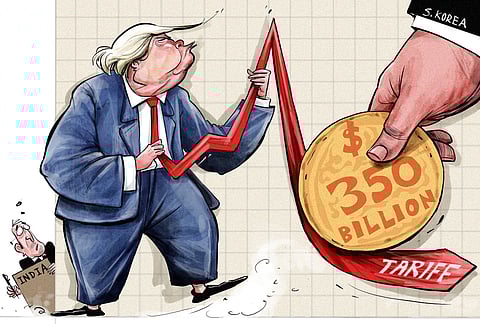

Donald Trump is learning that you cannot have the cake and eat it too. His lesson comes from America’s longtime ally, South Korea. It will be one of the most important lessons of Trump’s second presidency, although faraway South Korea is only about 10 percent of the size of the United States.
India and South Korea were both equal victims of Trump’s bullying soon after he moved into the White House for the second time. The Trump administration threatened 25 percent tariff on South Korean exports to the US, the same as India. If India is “tariff king” in Trump’s words, South Korea is not way behind because of its non-tariff barriers to imports and its ‘red lines’ on rice and beef imports from America. Last year, Seoul notched up a record surplus in excess of $50 billion in trade with the US. But on the eve of Trump’s August 1 deadline for trade agreements, South Korea reached a deal that fixed a highly favourable 15 percent duty on most of its exports to the US. A beaming Trump called it a “full and complete trade deal”. At the same time, tariffs on India soared to 50 percent.
There are lessons for India from South Korea’s trade deal with the US, which is yet to be on paper and has many rough edges. But then, that is the case with many of the deals the US has agreed to with its trade partners around the world. South Korea offered to invest $350 billion in the US to get Trump to reduce duties on its exports to America by 10 percent.
India could have done something similar by taking along India Inc when Prime Minister Narendra Modi called on Trump at the White House in February. The Ambanis, Tatas, Mahindras and other corporate leaders who have prior investments in the US could have gone to the Oval Office with Modi and told Trump that they would invest big in America. India is a much bigger economy than South Korea, which is only the 13th largest in the world. Any declaration on White House grounds that India Inc would pour—or rain—money on America would have been touted by Trump on his Truth Social microblogging site as yet another feather in his cap.
After all, that is what Trump wants, not concrete results. His most trumpeted promise of a border wall with Mexico in the 2016 election is yet to be fulfilled. Trump needs frequent shots of adrenaline that will boost his limitless ego and vanity. Historically, only 12-15 percent of declared intentions to invest are finally realised worldwide. Words are cheap. India’s corporate leaders could have gotten away with words, which would have been music to the ears of the 47th US president, and later done precious little about it in the three years that are left before the US elects another occupant of the White House.
Such gimmicks made Trump a friend of India in his first presidential term. Bilateral relations were smooth. Now India has abandoned its own textbooks from Trump’s 2017-21 stint and is paying a big price for this omission. It is true that other countries like the United Kingdom and Japan have creditably taken leaves out of India’s book this year. New Delhi could have more than matched them. Perhaps India came to falsely believe that Trump is a friend of this country.
India will regret that it gave up on flattering Trump and offering him lollipops like an invitation for the Republic Day parade. It is a fair certainty that Trump would not have the patience to sit through three hours of a parade along the national capital’s Kartavya Path, but the invitation would have pleased him. Like the invitation from King Charles of Britain for a state visit, which helped the UK to strike a trade deal early.
The cake that South Korea promised the White House in $350-billion investments was, it now turns out, beyond the East Asian country’s means. But Seoul needed the tariff concessions it got from Trump in exchange—South Korea was America’s seventh largest trading partner in 2024, according to the US government’s Bureau of Economic Analysis. Trump, however, wanted to eat the cake too.
That had more than just shades of fantasy. The ‘Make America Great Again’ President is now in the crosshairs of this fantasy of his own making. If Trump wanted the huge South Korean investments, he should have reined in his immigration officials or at least stopped them from releasing photos of workers at a Hyundai factory in Georgia in shackles for alleged visa violations, just like India’s undocumented citizens were deported on US military planes to Punjab in chains.
India did nothing about it, unlike South Korea. Its wealthy chaebol conglomerates are now reluctant to fork out much of the investments they had offered Trump. Yet, President Lee Jae Myung has cleverly avoided burning bridges with Trump by giving him the benefit of doubt. He told Reuters in a wide-ranging interview last month that the raid was not on Trump’s orders, but was the result of overzealous immigration enforcement. Lee knows how Trump’s mind works, something the Modi government appears to have forgotten.
Meanwhile, realising that the US is no longer a trusted strategic ally or reliable economic partner, South Korea is developing a second wing of its economy overseas. Like Singapore sparked off an ‘India fever’ on the island nation in the early 1990s with a famous declaration on its National Day 32 years ago, in tandem with India’s nascent economic reforms then.
India is South Korea’s partner of choice in this effort to diversify its international economic footprint. LG Electronics announced a week ago that India will be one of its global manufacturing hubs and is investing $600 million on a new factory in Andhra Pradesh. Along with another chaebol, Hyundai, South Korea is the first country to respond to India’s efforts to diminish the damage from Trump’s tariffs by extensively reducing goods and services tax rates. The Korea Investment Corporation, the country’s sovereign fund, recently opened an office in Mumbai. Seoul says its investments in India shot up 83.2 percent in the first quarter of 2025 over the same period last year. India’s response to these initiatives will indicate the future course of this bilateral business relationship.
K P Nayar | Strategic analyst
(Views are personal)