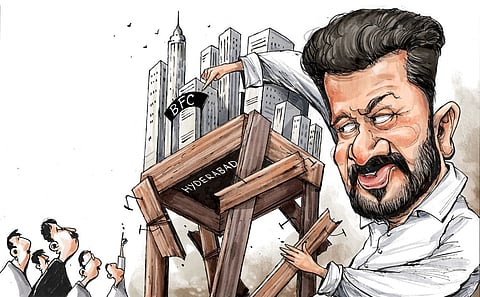

Telangana Chief Minister Revanth Reddy recently commissioned Bharat Future City (BFC), next to present-day Hyderabad—aimed to be a “net zero smart city” that will “mirror New York and Tokyo”. This is a laudable mission. However, sceptics would say that the entire objective of developing new cities in India is to create opportunities for rent-seeking. Liveability is only a marketing concern.
This is certainly true of all metropolitan cities that have grown in India in recent times. Pollution, chaotic traffic, appalling sanitation and garbage control, distressed housing conditions, and general ugliness are hallmarks of contemporary Indian cities.
The main wealth generator in any city is real estate appreciation, marked by the regular conversion of agricultural land for non-agricultural use, with the attendant corruption benefits to bureaucrats and politicians, and the largely unaccounted and untaxed capital gains from increase in land and property values, apart from infrastructure and liquor contracts. This is especially so in all peninsular cities where economic success has magnified this terribly unproductive accumulation. It is little wonder that Hyderabad’s gold and jewellery shops, being vehicles to hold unaccountable and illgotten wealth, outnumber other modern establishments. Bengaluru, Chennai, and Kochi are not far behind.
But I do not think that the Telangana CM is impelled solely by rent-seeking motives. He has articulated a clear vision for a better sort of city. His interventions to protect Hyderabad’s lakes reflect a genuine willingness to put political capital behind the cause of a better urban future. But I must strike some notes of caution which he must be mindful of and not get carried away, like many before him, by boastful future talk and an obsession with technical parameters.
First, who will execute the project? BFC is to be developed the time-honoured way, by an unelected development authority and an IAS-headed infrastructure corporation. It is common knowledge that, across India, such authorities chiefly engage in rent-seeking and are appalling at maintaining and prioritising the built environment and sustainability. For such quangos, capital expenditure is good as it brings a stream of rent-seeking benefits. Maintenance is low priority and service delivery is incidental. The result is the contemporary Indian city—poorly planned, unequal, and invested in rent-seeking.
Second, the same pool of people who have made a mess of Hyderabad will be tasked to execute BFC—the civil service, with IAS and IPS officers (for some reason, policemen in Telangana are considered transport and infrastructure experts) at the helm. This will only replicate the myriad troubles that Hyderabad faces, since these officers live in a gated world cut off from common urban citizens. They have zero expertise and terrible track record in creating world-class anything, except junkets to Davos.
To give just one example, the Telangana electricity distribution company has a hardworking workforce and no shortage of equipment. But due to substandard procurement and a management content with mediocre performance measured against the yardstick of Bihar or Uttar Pradesh, electricity goes off for 5-30 minutes once or twice daily in every neighbourhood except the residences of the CM and the governor.
This does not happen in any city worth the name—forget New York, not even in Bangkok, Johannesburg or Istanbul! Yet, it is normalised by a leadership that is accepting of mediocrity, whose parameter of success is “better than Bihar”. How can such mediocre leaders, even if not corrupt, be entrusted with an excellence-seeking project?
Gated communities are popular in Indian metros because they offer things that are unavailable to the general citizenry—roads to walk on, green areas, backup power, and water supply. Walk out of these communities and you see a Hyderabad with almost no walkable pavements, rubbish overflowing on the streets, unnecessary water puddles, and power supply failures.
If BFS is to be the envy of New York, will this sort of basic stuff be universally available? What then will happen to the existing capital of Telangana? Will its standards rise to meet that of the new city? Who will do this? The same Hyderabad administration that is failing to do so now?
If the intention is to build BFS as a gated community, then, learning from Gachibowli and the financial district, the mediocrity problem does not go away. Will denizens of the new city will be people like us, who throw rubbish on the streets, are indifferent to noise pollution and building laws, do not follow traffic rules and drive like maniacs? Will BFS abolish caste and ethnic ghettos? Or will people like us Hyderabadis be excluded altogether from BFS, which will be populated, serviced and staffed by people from Japan and the US?
The point is simple. Just as Cyberabad has degenerated, BFS will be no automatic paradise. Urban planning has to focus less on rent-seeking and more on 100 percent service delivery—to commit to excellence rather than relatively superior mediocrity. Political leaders and social movements (not babus and policemen) will have to do what government cannot— foster a rules-based traffic system (learn from Mumbai and enforce helmets, for a start), social consciousness about rubbish disposal and spitting, 24/7 electricity and water supply, pavements to walk on, and other such things that are markers of excellence—not large, ugly, shiny high-rises, flyovers that flood whenever it rains, and vaastu-compliant villas.
The metric of success for BFS will be a transformed present-day Hyderabad—from Barkas to Gachibowli—with walkable pavements, universal power and water supply, decongested and law-abiding traffic, and enforced building and zoning regulations. No city in the world—think New York, Tokyo, Shanghai, Istanbul—has expanded successfully before fixing the existing urban space.
CM Revanth Reddy garu, I believe that you genuinely want to make your mark on history. But for this, you need to deliver in the Hyderabad you currently govern before ‘lotus eating’ about new satellites. You have the drive and the political mandate to do this. Do not make the same mistake as those before you and buy the technocratic hype that the bureaucrat-consultant ecosystem, hungry for new sources of extractive wealth accumulation, is feeding you.
Rathin Roy | THE PENINSULA | Distinguished professor at Kautilya School of Public Policy, Hyderabad; visiting senior fellow, Overseas Development Institute, London
(Views are personal)
(rathin100@gmail.com)
