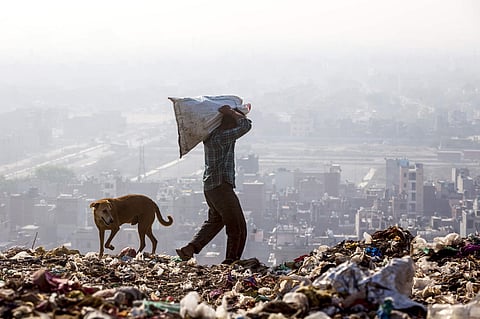

Some years ago, I was editing a newspaper in Mumbai and we ran a report on the city’s eternal garbage problem. The report mentioned a prime spot in the suburbs where a mountainous garbage landfill was posing a danger because vultures were wheeling over it, getting in the way of air traffic. The report did not go down well, as the proprietor of the newspaper happened to own the landfill. This column is not about my adventures as a journalist, but about India’s garbage problem.
Unlike the West, where the age of chips has followed a certain social and cultural stage that necessitated garbage collection in the cause of health and aesthetics, India seems to have skipped that stage. As a result, we might have to drive through rotting waste while heading to a robotics factory.
Mumbai, Bengaluru, Delhi, Chennai—the waste piles high everywhere. In the capital, the waste is dumped 65 metres high at one landfill. It’s not taller only because the Municipal Corporation of Delhi is not great at collecting waste. This mountain, like many in other Indian cities, symbolises the country's struggle with solid waste and will soon ascend new heights.
Garbage output is expected to reach 62 million tonnes this year and could soar to 436 million tonnes by 2050. A developing India means more waste, but we have no idea what to do with it except, at best, transfer it from one spot to another and hope the dogs and vultures will do a good job.
We have some 2,500 official landfills. And millions of unofficial dumpsites in our backyards, gutters, footpaths, and rivers. All of India is potentially a landfill. Nearly 80 percent of the waste that finds its way to these is unprocessed. Organic waste mostly rots, but plastic is more or less eternal. Organic waste emits methane. But it is more fashionable— and profitable—to focus on carbon emission, possibly because there are more fellowships, seminars, and grants available to study it.
Western nations have adopted more effective waste management strategies. In the US, 51 percent of waste goes to landfills, a practice supported by recycling efforts like composting. A couple of months ago, I was in Minnesota and Washington, and could not find a scrap of waste on footpaths. The waste is well collected and recycled. We don’t collect too good and we litter. But how much do we recycle? There is no clear data on this.
In Europe, there is a hierarchy of waste management that prioritises prevention, reuse, recycling, and recovery, achieving a municipal recycling rate of 49 percent. The Nordic countries exemplify the best practices. In Sweden, 65 percent of municipal solid waste is incinerated, generating energy for a significant portion of Stockholm's homes, while recycling rates remain high at 49 percent. Finland mirrors this success, with landfilling dropping below 1 percent since 2020.
In these countries, waste is almost lovingly sorted and managed, transforming what was once discarded material into energy or reusable resources. We are an energy-deficient country. When was the last time you heard someone raise a question in parliament or a state assembly on recycling waste into power? Or indeed, waste into anything?
Kerala, where I come from, wastes no opportunity to pat its back while dumping trash into fields and canals. Kochi, Kozhikode, and Thrissur are mosquito breeding centres. Waste mismanagement in the state is probably one reason it holds records in disease outbreaks.
The Swachh Bharat Mission, initiated in 2014, aimed to tackle the waste crisis with significant funding—with over ₹1.5 lakh crore allocated since its inception. The budget for 2025 remains robust at ₹12,192 crore, encompassing urban and rural initiatives. Why is it then that many areas in cities like Gurgaon and Bengaluru are facing a trash crisis? The mission’s problems include the fact that it is not audited.
Our ‘model villages’, a typical Indianism, are often models because bureaucrats are more into meeting numbers—a newfound Stalinist passion for statistics, to be precise. Add to it the all-too-human need to protect one’s career, felt by everyone from judges to sweepers. I suppose a poor country will instinctively get its individual priorities right.
To be fair, environmentalists often focus on carbon emissions because they recognise that addressing climate change can have far-reaching impacts on public health, ecosystems, and future generations. While solid waste management is essential, the urgency surrounding carbon emissions stems from their immediate and long-term effects on global warming and environmental degradation.
However, there are some signs of change. Small signs, though. Involvement of corporate giants like Reliance indicates a shift in how waste is being viewed in India. Mukesh Ambani's company is investing heavily in biogas facilities and chemical recycling initiatives that convert single-use plastics into reusable materials. Companies like Attero Recycling are using AI to streamline processes, while others are transforming agricultural waste into marketable products.
India's waste management crisis is not insurmountable, given the availability of technology. By learning from the effective strategies employed in other countries, India can reduce its rubbish mounds. What stands in the way is as much incompetence as our cultural practice of mere transference of waste from one spot to another.
C P Surendran | The author’s latest volume of poetry is Window with a Train Attached
(Views are personal)
(cpsurendran@gmail.com)
