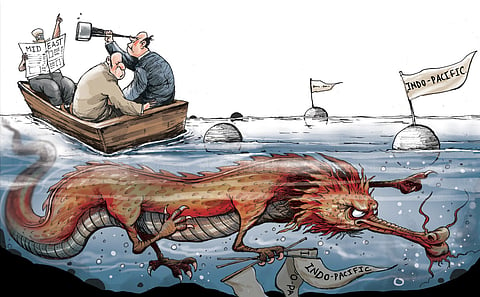

For almost two years, the Indo-Pacific seemed to drift off the front pages of geopolitics. The US’s attention was consumed by wars in Europe and instability in the Middle East. The headlines spoke of Ukraine, Gaza, and energy crises, not of the South China Sea or the Indian Ocean. Yet this pause in attention did not mean the competition was over. It merely meant that while the world was distracted, Beijing was quietly at work—consolidating presence, deepening dependencies, and shaping norms that make its future dominance seem inevitable. The US withdrawal from Afghanistan was intended to facilitate contestation of influence in the Indo-Pacific, but other events intervened.
The strategic lull has consequences. China used this period to strengthen its position through what might be called the ‘art of incremental advantage’. Ports, infrastructure projects, and logistics agreements have given it a wider footprint across the Indian Ocean—not in the overt form of military bases, but as dual-use platforms offering flexibility for future use. Kyaukpyu in Myanmar and Ream in Cambodia, for example, began as commercial projects and evolved into virtual dual-use footholds. This is all capability under development. The lesson is clear; in the Indo-Pacific, neglect is not neutrality. It only creates an opportunity for China.
The US, despite its still formidable naval presence, has struggled to sustain the energy it once invested in the ‘Free and Open Indo-Pacific’ (FOIP) concept. The Donald Trump administration’s second term has been more transactional, with foreign policy viewed through the prism of immediate deals, crisis management, and perhaps the Nobel ambition. Europe’s anxieties, the Middle East’s fires, and domestic priorities have meant that the US bandwidth has been thinly spread. The Indo-Pacific strategy now works in fits and starts, but the theatre often drifts into diplomatic low tide.
The result is an environment where the Quad—India, Japan, Australia and the United States—continues to exist, even function, but without the rhythm of sustained coordination that true deterrence demands. Its members are doing meaningful work: improving supply-chain resilience, mapping critical minerals and building maritime cooperation. However, a network requires constant power to stay lit; a few bursts of attention cannot replace a steady current. In the absence of continuous engagement, China’s advantage grows not through confrontation, but through continuity.
A second development complicates matters further: the recent cooling in Indo–US relations and Washington’s revived interest in Pakistan. The return of Pakistan to Washington’s radar, ostensibly for regional stability and counterterrorism coordination, risks reducing the US leverage over Islamabad’s more destabilising impulses. It also diverts American diplomatic energy from that very partnership that was supposed to anchor the Indo-Pacific balance.
When political trust erodes, even slightly, strategic cooperation loses its rhythm. If New Delhi doubts Washington’s reliability or long-term intent, it becomes less willing to align too visibly with any coalition that appears to target China. The result is a subtle but real thinning of coordination—not a rupture, but a reluctance. In that space of hesitation, China gains.
This dynamic is producing a new kind of regional balance; less US-led, more decentralised, but obviously less effective, too. India, Japan, and Australia are increasingly pursuing autonomous strategies—developing capacities, building mini-lateral arrangements, and deepening bilateral defence cooperation even outside the American umbrella. It is not an anti-US trend; rather, it is a recognition that resilience cannot depend on one capital’s attention span. The Indo-Pacific may thus evolve into a loose network of capable regional powers, each balancing China in its own way— rather than a single Western-led front.
The deeper question, however, is whether this lull makes conflict in the region, particularly over Taiwan, more or less likely. The answer is nuanced. On one hand, when the US attention appears divided, Beijing might perceive a window for greater coercion or grey-zone tactics. On the other hand, China’s leadership understands the catastrophic economic and military costs of a full-scale war. Thus, instead of outright invasion, we are more likely to see calibrated hybrid pressure— military exercises, cyber operations, economic coercion—aimed at eroding Taiwan’s will and testing allied unity.
The Indo-Pacific’s danger today is not an imminent great war, but a gradual erosion of deterrence and trust. Each instance of disengagement, each gap in coordination, creates space for revisionism to become normal. That is what needs to be arrested.
For India, this moment demands renewed clarity. Its strategic stakes in the Indo-Pacific are direct and existential— sea lanes for trade, energy routes, and a stable maritime order that prevents coercion. India must therefore resist the temptation to turn inward or become preoccupied solely with its continental frontiers. The next decade will test not only India’s military readiness but also its diplomatic stamina—the ability to engage simultaneously with Southeast and East Asia, the Indian Ocean islands, and partners across the Pacific.
Delhi’s approach should be both pragmatic and persistent. Strengthen maritime domain awareness; invest in logistics and coastal infrastructure that serves both development and defence; expand partnerships in disaster relief and climate resilience; and, above all, remain visibly present in every major Indo-Pacific forum. Influence in this region is not claimed once—it is renewed daily.
The good news is that while China may have gained ground, there is still enough space. Many smaller states still value India’s developmental model and inclusive diplomacy. The Quad, despite its uneven pulse, retains real potential. And Washington, even in transactional mode, understands that ceding the Indo-Pacific would be strategically catastrophic. The upcoming ASEAN Summit in Kuala Lumpur, which is expected to attract several major leaders, could mark the resumption of a more concerted engagement.
The Indo-Pacific, then, is not lost—it has merely been left unattended for a while. The challenge for the world’s democracies, and especially for India, is to ensure that this pause does not harden into a pattern. As attention returns to the Pacific’s vast waters, the task is to restore not just presence, but purpose. Because in geopolitics, as in the sea, the tide waits for no one.
Lt Gen Syed Ata Hasnain (retd) | Former Commander, Srinagar-based 15 Corps; Chancellor, Central University of Kashmir
(Views are personal)
(atahasnain@gmail.com)
