
What does it truly mean to educate a young person? Is it simply about filling their heads with formulas, dates, and grammar rules, or something more profound and lasting? Is education supposed to only prepare students to pass exams and get jobs, or should it also shape them into thoughtful, independent, and self-aware human beings who can navigate life with confidence? Denmark appears to have answered these questions in a manner few other countries have dared to attempt. Its fascinating efterskole system offers 15-year-olds a precious gift: an entire year spent not chasing grades or test scores, but exploring who they are, what they enjoy, and how to live well with others. This isn’t a dream for nearly one in three Danish teens—it’s a reality.
For that year, these young people live at a boarding school. They cook their meals, clean their rooms, share chores, and learn to manage their daily lives. Sure, they still study core school subjects like math and languages, but the real focus is personal growth. Music, drama, art, sports, or technology become pathways of self-expression. There are no formal exams; no cramming for tests. Instead, they learn something most school systems forget to teach: how to be human. And the results are striking.
Research shows Danish students attending efterskole are more likely to finish high school. But more than that, they emerge from the experience as confident, adaptable, and emotionally mature young adults. They are better equipped not only to study but also to live. They know how to share space with others, handle conflicts, and organise themselves; most importantly, they have a better understanding of who they are.
Ireland offers a similar, though slightly shorter, experience called the ‘transition year’. Students there also take a break from conventional studies to explore the arts, work experiences, and new skills. It is no coincidence that actors like Cillian Murphy and Paul Mescal credit this year for shaping their careers. Germany’s Waldorf schools and Finland’s student-centred models share echoes of this holistic approach. Even the American ‘gap year’ before university serves a related purpose, helping young people pause, think, and grow before plunging into adulthood.
However, there is an uncomfortable truth here. This model, as beautiful as it is, depends heavily on wealth, social trust, and government support. Denmark can afford this because its tax-funded welfare system makes education accessible even to middle-class families. Boarding, supervision, extracurricular freedom—all of this costs money. For poorer countries, such a system feels impossibly distant.
Culture matters, too. In nations like India, Nigeria, or Bangladesh, education is often seen as a survival tool—a high-pressure ladder to escape poverty. Parents want their children to focus on medicine, engineering, and law, not poetry, pottery, or self-discovery. A year spent learning to ‘find oneself ’ sounds like a luxury that low-income families cannot afford.
So, is efterskole just a rich country’s indulgence? Not necessarily. Although poorer nations may not be able to copy the model entirely, its spirit—the belief that young people need space to grow as humans, not just as workers—can still be adopted in practical ways.
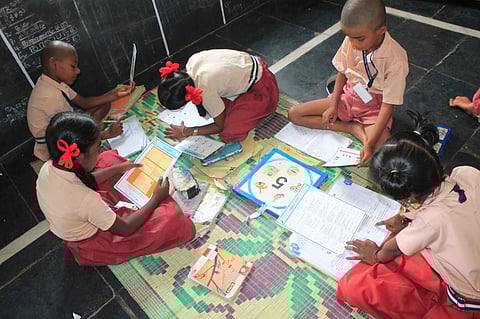
India has already taken quiet but meaningful steps in this direction. Though the system remains largely exam-focused, there have been notable shifts. One standout is Tamil Nadu’s activity-based learning (ABL) programme, introduced in 2007 for early grades in government and aided schools. ABL breaks from rote learning, offering child-friendly, activity-driven, and self-paced education. Instead of lectures and memorisation, students learn through activity cards and visual ladders, progressing at their own pace. Multi-age, multi-level classrooms further encourage collaboration and dissolve rigid hierarchies.
What makes ABL especially significant is its deliberate focus on non-cognitive outcomes: student confidence, social interaction, emotional engagement, and curiosity. These are the very foundations of the efterskole philosophy, minus the dormitories and year-long immersion. And the results are encouraging: improved learning outcomes, lower dropout rates, stronger teacher-student bonds, and higher student participation.
While ABL focuses on younger students, its spirit can, and should, reach higher levels. Across India, various initiatives, from life skills programmes to youth leadership camps, are already blending academic and emotional learning. In many ways, these are Indian versions of the efterskole idea. They may not resemble Danish boarding schools, but they share the same goal: educating the whole person. Short retreats, arts workshops, and community service projects could be scaled up across schools, giving teens space to explore, collaborate, and grow, without disrupting their academic path.
None of these efforts will succeed unless parents and policymakers begin to value what is not easily measured: confidence, empathy, problem-solving, and resilience. These are not soft extras but survival skills in a changing world. Today, employers from tech to healthcare rank emotional intelligence, communication, and adaptability among the top hiring priorities. The world is shifting, and so must education.
The message from the efterskole model is universal: teenagers deserve more than academic drilling. They deserve the chance to learn how to live. And countries like India are proving that even in resource-constrained settings, honouring that message in context-appropriate ways is possible.
John J Kennedy | Former Professor and Dean, Christ (Deemed) University, Bengaluru
(Views are personal)