
Pitrpaksh is currently underway, from September 7 to 21. It is an annual event in the Indian calendar when Hindus pay homage to their pitris, or ancestors, both known and unknown, with oil lamps and offerings. Since their core text, the Bhagavad Gita, and generations of Indian names come from the Mahabharata, I thought it would be appropriate to revisit that timeless tale during this solemn period of remembrance.
Everyone has presumably read the Mahabharata by Vyasa in some form or another. As it is one of India’s two major epics, the other being the Ramayana, it’s virtually a karmic duty to have read it. Vyasa’s craft as a master storyteller keeps it racy, pacy, and unputdownable through the Mahabharata’s eighteen parvas or sections. He delights in setting people up for a big fall, and the tension never abates. In fact, you need nerves of steel to stay with the story; it is so intense when read in close detail.
Having said a few things to frighten you off the book, let me share why I feel it is so relevant, moving, and necessary to re-read it. Across Indian epics, the concept of karmic repercussion is the explanation for why bad things happen. There are too many external variables to control. So, what can one actually control in this out-of-control existence except one’s own response to situations and relationships?
Of these responses, anger is consistently identified as the worst destabiliser through story after story. Therefore, by removing oneself from anger, one’s karmic consequences may be reduced and may even be nullified, to break free of the endless cycle of birth.
In contrast to Duryodhana, Yudhishthira is a prime example of this approach, always seeking to tone things down to a state of calmness. But it does not come easy. Draupadi and Bhima constantly reproach and fight with him about his ‘peacenik’ attitude. It churns the stomach to read what they spew.
The foundation of anger in the Mahabharata is not just personal but also political. It is the anger of mighty Jarasandha of Magadha, when foiled by the young Sri Krishna, in his intent to take over Aryavarta. He invades Mathura seventeen times, finally causing Krishna to move his people to safety in Dwaraka on the coast. Besides this, other monumental layers of anger create further dynamics—the anger of Amba, the anger of Drona, the anger of Duryodhana, the anger of Draupadi, the anger of Ashwatthama, and, in a shattering finale, the brawling doom of the Vrishnis that marks the passing of the Krishnavatara and the end of the epoch.
As we read, we come to know Vyasa better, especially his high literary confidence. He does not hesitate to cast even his most virtuous characters in an ambivalent light, demonstrating that no human being is perfect. Karna, Yudhishtira, and Arjuna are striking examples of this. Conversely, Duryodhana has his positive moments, when he elevates the then outsider Karna to the king of Anga, disregarding his social status.
The longest and possibly the most popular parva in the Mahabharata is the Vana Parva or Forest Section, in which the Pandavas spend twelve years exiled in the forest. It contains many gems that have been explored by the performing and visual arts of India, for instance, the story of Nala and Damayanti.
Also, the episode of Yaksha Prashna is a gripping passage on the nature of life, in the form of a dialogue between Yudhishthira and his father, Yama, disguised as a Yaksha or nature spirit. In the middle of a war story, we hear the question: “What is the highest duty in the world?” and Yudhishthira’s profound answer: “To not hurt others is the highest of all duties”.
Charming events occur, as when Rishi Markandeya visits the Pandavas twice in exile, in the Kamyaka forest to the west of the Kurukshetra plain, and in the Dvaitayana forest on the border of the Thar Desert. Once, his visit coincides with Krishna’s.
The rishi is a great favourite of theirs since he is a good storyteller. They sit around him, and Krishna says, “Please tell us a story, tell us lots of stories.” It conjures up a vivid picture of Krishna, the Pandavas, and their followers seated around Sage Markandeya in a verdant grove, all listening to stories—touchingly different from the typical battlefield images and chocolate-box Krishna pictures that we are used to seeing in calendar art.
The stories told in the Mahabharata constantly shore up the concept of karma. There are also frequent utterances by the Pandavas that ‘it is all fate’ and ‘who can escape fate?’ Kunti laments, “Bhagyavantamparasuyeta ma shooram ma cha panditam”, meaning, ‘Only the lucky can prevail, not the brave nor the learned.’
Is there a way out of their understandably fatalistic view? Yes, there is, avers the epic. We have to wait, though, until that electrifying moment on the battlefield of Kurukshetra when Krishna imparts the Bhagavad Gita.
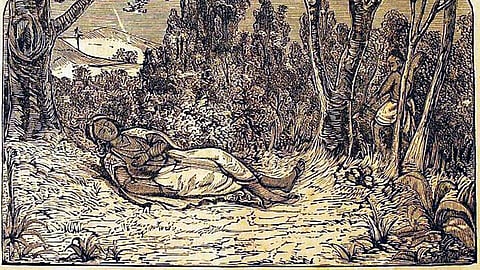
The most haunting passage for me is the passing of Krishna near the end, after he completes 125 years on earth. It is unbearably sad to read, but I read it nevertheless, assured of his eternal presence. My foremost takeaways from it are marvel at Vyasa, and the drained yet elated feeling of having completed an important journey into the heart of the human condition. If, at the end of reading the Mahabharata, we find that we were moved by pity and terror, and attained a valuable perspective on life, we belong to a very old family of countless pitris.
Renuka Narayanan | FAITHLINE | Senior Journalist
(Views are personal)
(shebaba09@gmail.com)
