
THE CONSTITUTION OF INDIA
Part III—Fundamental Rights —Article 19 Right to Freedom
19. (1) All citizens shall have the right—
(a) to freedom of speech and expression;
(b) to assemble peaceably and without arms;
(c) to form associations or unions;
(d) to move freely throughout the territory of India;
(e) to reside and settle in any part of the territory of India
It took governments across the nation less than a fortnight to demonstrate how vulnerable the promise of freedom is in the absence of political will. In a pathetic display of basic governance, the provisions guaranteed by the Constitution were allowed to be perverted.
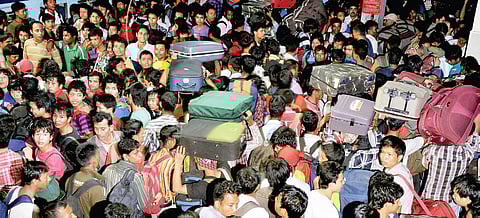
People were forced out of their homes in Assam in a bloody riot and forced into camps. In Karnataka and Maharashtra, thousands of boys, girls, men and women from the Northeast, terrorised by threats, fled colleges and homes, packed like sardines in trains, to safety. In stark contrast, Gopal Kanda, accused and sought by the law, could roam freely for 11 days before eventually ‘surrendering’ for arrest; those perpetuating terror moved freely throughout the territory of India deploying digital and analog methods. Armed goons could — despite the presence of the police — subvert a freedom into a right to bring Mumbai to a standstill for hours. We were also informed by the CAG that for six years, the political class and the corporate class associated to form a union to appropriate national resources, transfer public monies to private pockets.
In every instance, the State — the governments in Assam, Karnataka, Maharashtra and elsewhere — simply watched as its writ was hijacked. The freedom promised by the founding fathers of the Constitution is explicit. Their successors have made it implicit, conditional on political expediency and the force of outrage.
On Friday, Members of Parliament cutting across the political spectrum assured Indians from the Northeast that they could live and work anywhere in the country. Indeed, what could be more ironic than the fact that 65 years after Independence, the Parliament of India needs to assure Indians that they have all the rights being Indian. What could be more tragic than the fact that the highest body in the nation needs to intervene to enforce the most basic of tenets of governance, the safety of Indians.
There is no denying, though, that the intervention was required to assuage a worried people—these are the states that form the border of the nation on its most vulnerable front—and demonstrate political will. But it is not enough. Could those who perpetuated terror have functioned without the tacit political support? The government has banned sending of bulk SMS (and some parties have demanded controls on social network sites). It’s almost as if the medium is at fault! Is it enough to ban bulk short message service? What about those who promote the message? Be it the chasing out of Tamils from Bangalore during the Cauvery riots or the violent attacks on Biharis in Maharashtra or the vicious language used against Purabis in Delhi, in every instance the catalyst has been a sectional interest of the political class. There is no guarantee that this won’t happen again because there is no deterrence.
The perversion of law persists because of the politics, the benefits that parties derive from it. The continuation of a state of affairs cannot be obtained without the active participation of the political class. This is just as true in the economic sphere too. In 2010, the CAG declared that the 2G policy had resulted in the loss of `1.7 lakh crore to the exchequer. The government then typically rubbished the report and Kapil Sibal even said there was ‘zero loss’. The Supreme Court eventually cancelled the licences. In 2012, the government has been informed that the manner in which coal blocks were allocated has resulted in a loss of `1.8 lakh crore to the national kitty. Yet again, the government has rubbished the report.
The Opposition may pretend to be on higher moral ground, but it cannot escape a share of the blame. For instance, in the ‘Coalgate scam’ did any of the parties object to blocks being allocated on a case-by-suitcase basis and suggest auctions? Indeed, state governments objected to auctions. Conviction cannot be a matter of convenience.
The problem with the discourse on the scam is that it focuses on quantum of loss or the methodology of the CAG. It needs to be about the existence of huge vaults of discretion regularly being tapped into by political parties — both Central and state governments. It is no secret that the 1991 reforms merely removed the provision of licensing. The politics of economics is just as extractive as it was during the licence raj. Between 1991 and 2012, virtually every party has been in power at the Centre. The point is the dismantling of discretion raj has not been a priority for any of the parties.
It is arguable that government policies may be — repeat may be — dictated by larger public good. If it is so, then that argument needs to be articulated and it must be heard loud and clear. If the UPA government believes that the CAG has stepped beyond its brief, then it must state so explicitly at the highest level, not resort to whisper campaigns and allude to motives. If it wants people to believe that it will enforce the writ of the State and protect fundamental rights, then it must demonstrate this in letter and in deed. The political executive must speak up and convince the people. Or it should be man enough to admit to the blunders. Unfortunately, that is not to be.
The spectre of chaos suggests India awaits its own Godot.
shankkar.aiyar@gmail.com
Shankkar Aiyar is a senior journalist who specialises
in the politics of economics
- Sunday Standard