
How do grand declarations of change get lost as they journey through the corridors of power? Why are policies touted as panaceas mired in a traffic jam of failures? There can be many alibis, but few explanations are succinct. In 1843, Karl Marx observed that those at the highest point in the governance architecture believe that those below know the granular details; and those in the lower echelons believe that those higher up understand issues. Betwixt this mutual deception lies a stack of failed and flailing policies.
Marx’s critique of bureaucracy was not just about babudom; it was a critique of the State itself. The question hour in every session of parliament produces a treasure trove of evidence. Here are a few vignettes on the state of governance that is yet to merit the necessary debates.
There has been a gush of reform talk in past weeks following the notification of the new labour codes. Two committees have been tasked with unclogging the regulatory pipes following the promise of regulator reforms in Budget 2025. What is the gap between political intent and ground reality?
Consider these nuggets from parliament. The potential of solar power is a pillar for the India Story. But how easy is it to set up solar projects? Not very, it seems. Solar projects, as per the government, require “a total of 116 approvals and permits”. Permits take time and translate into costs. India imports 250 million tonnes of coal because its reserves are stranded. Operationalising new mines takes time. A Parliamentary Standing Committee reveals that environmental clearance for mines takes 26 months, forest clearance around 34 months. Even the sarkar is haunted by permission raj. Over 320 Smart City projects costing Rs 9,425 crore are stuck due to delays in clearances.
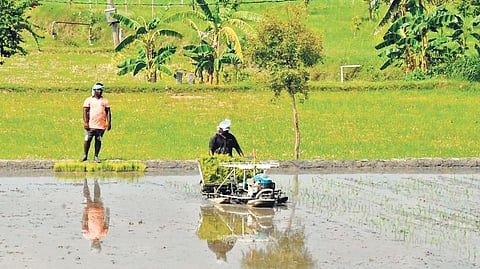
India’s farmers struggle with small land holdings, lower yield, and poor incomes—nearly half the workforce depends on a sixth of the national income. Political parties have reduced them to a constituency for charity. Despite decades of policies on food processing, post-harvest losses continue to erode output and farmer incomes. Last week, the government informed parliament that India loses 12.3 MT of cereals, 1.37 of MT pulses, 7.3 MT of fruits, 12 MT of veggies, and 30 MT of plantation crops due to inadequate investment in post-harvest processing facilities. For agriculture, redemption is like Godot—a promise yet to arrive.
Public sector banks wrote off Rs 6.15 lakh crore in five years. The disclosure in parliament triggered outrage. Meanwhile, the process of addressing insolvency and bankruptcy is far from efficient. Banks claim the shift from debtor-in-control model to a creditor-in-control under IBC Code 2016 has proved a deterrent. That said, timely resolution is still an aspiration.
Data from the Parliamentary Standing Committee on Finance merits attention. There are over 7,000 cases accounting for over Rs 10 lakh crore of claims pending admission. At the current rate of disposal, it would take 10 years to clear the backlog. The government says the average recovery is 28 percent, which translates to a 72 percent haircut; recovery, which varies by sector, is 17 percent for textile and pharma. The volume of pendency and value of recovery symbolise faultlines.
Unemployment is a permanent invitee to election campaigns and impacts the youth vote. The government unveiled a programme to provide internship opportunities to one crore youth in five years. The idea was promising, as it blended public and private initiatives. How has it done? Parliament was informed that in the first round of the PM Internship Scheme, 6.27 lakh applications for 1.21 lakh opportunities were received. Partner companies made 82,000 offers to over 60,000 candidates, of which only 8,700 were accepted—and worse, 4,565 candidates left before completion. In the second round, 4.55 lakh applications were received for 1.18 lakh opportunities. As of November, partner companies made 83,000 offers and 7,300 candidates joined. The designers of the policy must explain the gap between the need and low acceptance.
It is not that the government has no jobs to offer. The Union government has over 9 lakh posts vacant and state governments have even more unfilled posts. At every session, MPs ask about the shortage of teachers and vacant teacher posts. Typically, the Union government claims it has no data, as “education is a state subject”.
The dodge is illogical since the Centre spends Rs 41,000 crore on the Samagra Shiksha Mission. It must know and it does know. Indeed, the August report of the Standing Committee on Education reveals that 9,82,662 teacher posts are vacant. The figure in 2023 was 9,86,565, and has been near the million mark for a decade.
The paradox of unemployment and unfilled posts has persisted for over a decade. There is no dispute on whether India needs better policing. Yet, over 5.92 lakh police posts across states are vacant. Two of the most populous states top the table—Bihar with 68,000 and UP with 1,11,000 vacancies. The state of preventive healthcare is explained by the poor staffing of the rural infrastructure. This includes 9,300 unfilled doctor posts, 17,500 obstetricians, gynaecologists and surgeons, 3,200 radiographers, 4,900 pharmacists, 7,900 lab assistants, and 22,500 nursing staff.
It is possible to steer narratives and dodge anti-incumbency with freebies, but it is useful to remember populism, too, is governed by the statute of limitations. The mounting failures in governance illuminate the chasm between the promise of representation and the reality of the represented—a gap that is measurable in the echo of unanswered questions.
Read all columns by Shankkar Aiyar
Author of The Gated Republic, Aadhaar: A Biometric History of India’s 12 Digit Revolution, and Accidental India
(shankkar.aiyar@gmail.com)
