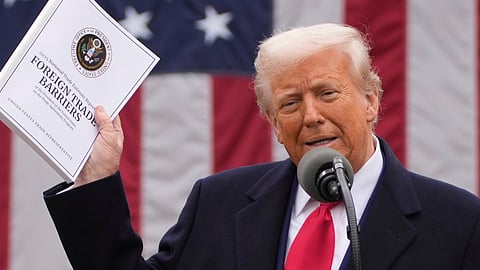

He did it again. Just before midnight on Thursday, US President Donald J Trump took to Truth Social and declared in capital letters: “All trade negotiations with Canada are hereby terminated.” The reason: the province of Ontario in Canada put out a TV spot using a radio address by former US President Ronald Reagan where he argues against protectionism and says tariffs put jobs and growth at risk.
The next morning, Trump dubbed the ad a “fake”, citing the Reagan Library. He said Reagan “loved tariffs”. The TV spot pierced the soft underbelly of continental history. In October 1987, Reagan and Canadian PM Brian Mulroney signed a free-trade agreement and laid the foundation for what came to be known as NAFTA including Mexico. Trump’s post amped up the reach of the TV spot that aired again on Friday night during the Blue Jays-LA Dodgers World Series baseball match.
It is true that the TV spot used poetic political licence to cherry-pick its message. Reagan did push through the Plaza Accord in September 1985 and got the G5—the UK, France, West Germany and Japan—to sell dollars to enable its depreciation and help US’s export competitiveness. Reagan also imposed tariffs on Japanese semiconductors. But dubbing Reagan a lover of tariffs is a hard-sell given popular perceptions of the Cold War warrior. History shows that typically, US presidents wax in Jeffersonian words and act Hamiltonian.
The Declaration of Independence charged King George “for cutting off our trade with all parts of the world”. But protectionism was both promoted—by the likes of Alexander Hamilton—and opposed. Thomas Jefferson evangelised free trade, but enacted the Embargo Act of 1807 and the Non Intercourse Act of 1809 banning trade with the UK and France. Trump’s favourite President William McKinley passed the Dingley Tariff Act 1897 to impose 49 percent tariff.
Warren Harding pushed the Fordney-McCumber Tariff Act and Herbert Hoover passed the infamous Smoot Hawley Act. In the inter-war period, Woodrow Wilson and Franklin D Roosevelt criticised protectionism and JFK proposed the Trade Expansion Act in the Cold War era.
Cut to 2025 and back to Trump’s tantrums. It is over 207 days since Liberation Day. Trump’s claim of a queue of trade deals is unravelling. The u-turn on Canada—the second biggest customer of US farmers—is not the exception. The deal to no-deal whiplash is indeed a Trumpian pattern.
The US is yet to formalise a framework for trade with Mexico, Canada and China—the countries with which it has the largest trade deficits. Talks with Mexico are on, but are complicated as stalled talks with Canada leaves the three-country USMCA in limbo. Negotiations with Brazil, with whom the US enjoys a surplus, is marred by politics. The US-Japan deal is up for review this week. The US expects Japan to invest $550 billion; Japan sees only 2 percent of it as investment and the rest as loans.
Talks with China present a surreal spectre. In April, the US imposed a 145 percent tariff and China retaliated with 125 percent. Between July and September, the US expanded export bans on semiconductors and China restricted access to rare earths. In October, US imposed port fees on Chinese vessels entering US ports, and China responded in kind. US-China talks have travelled half the globe—Geneva in May, London in June, Stockholm in July, and Madrid in September—and the next round is in Kuala Lumpur this weekend. The consensus view on the likely outcome of a Trump-Xi Jinping meeting is another 90-day extension.
India was among the first countries engaged in trade talks—soon after the visit of PM Narendra Modi to Washington earlier this year. The negotiations stalled post May as the US imposed 25 percent more on India for buying Russian crude. The hypocrisy is stark. There is no penal tariff on others. And the US continues to import from Russia goods such as fertilisers, chemicals, nuclear reactor machinery, low-enriched uranium and palladium.
This week, the US imposed sanctions on Russian oil majors Rosneft and Lukoil, impacting India’s energy security. Germany is trying to get exemptions for Rosneft refineries in its territory. Unsurprisingly, Commerce Minister Piyush Goyal asked, “Why single out India?” Following an outreach by Vice President J D Vance and Trump’s Diwali call to Modi, there has been progress even as India cautioned it will not sign a deal at gun-point.
Trump, it could be said, drives and thrives amid chaos. However, there are limitations to the declare-and-defer approach. Trump’s ambition of achieving multiple objectives—ideological, geopolitical and economic—hasn’t quite panned out. Exhibit A: the tariff on Brazil was intended to bail out Jair Bolsonaro. Exhibit B: the penal levy on India was to get Vladimir Putin to the peace table.
Trump says the US is wealthy again and the stock market stronger because of tariffs. In reality, the tariffs have brought in $190 million, but barely dented the twin deficits. Sure, the S&P500 is at a record high, but that’s thanks to the 36 percent heft of the Mag7 tech stocks. Within the US, auto giants and retailers laid off workers and the IMF lowered US and global growth estimates.
Trump campaigned as a hawk on trade, but the deal-maker seems at a loss for direction. Worse, he is afflicted by whimsies. The world, meanwhile, must consult Shakespeare’s Hamlet—in which Polonius says, “By indirections find directions out”—to divine the Don and decide to deal or not to deal.
SHANKKAR AIYAR
Author of The Gated Republic, Aadhaar: A Biometric History of India’s 12 Digit Revolution, and Accidental India
(shankkar.aiyar@gmail.com)
