
The money factor
In the world of cue sports, snooker has seemingly marched ahead of billiards. Though the International Billiards & Snooker Federation (IBSF) has added the points format to the timed format to sustain interest in billiards, and traditionalists still swear by this form of cue sport, snooker is where the money is. Whereas the world professional snooker circuit has millions of pounds in prize money, the world pro billiards and IBSF titles offer little by way of financial reward to winners.
Here’s a comparison: In 2009, John Higgins beat Shaun Murphy to win the world pro snooker championship conducted by the World Professional Billiards and Snooker Association (WPBSA) and pocket the winner’s cheque of £250,000. The prize money on offer for the world pro billiards championship (timed format), also conducted by the WPBSA, is £6000. The IBSF conducts world billiards championships in the timed and points formats. The prize money is about £5000.
At the same time, it is very tough to break into the professional snooker circuit — that is how India’s Yasin Merchant, who spent six years in that competitive world, describes his experience. Yasin turned professional in 1992 and rose to 65 in the rankings while on the pro snooker circuit till 1998. In fact, Yasin and Alok Kumar, the Asian champion in 2004, are the only Indians to have played snooker at the international level as professionals.
“At that time, there were more than 1,000 players on the pro snooker circuit and breaking into the top 600 was considered credit-worthy. Now, there exists a system whereby you have to play 10-12 tournaments before you can hope to get into the top 100 or 200. The biggest incentive in professional snooker is that you get a chance to compete against the very best,” says Yasin. “In Asian snooker, cueists from China and Thailand are superior to others. Not surprisingly, most of these players are on the pro circuit,” he adds.
A different ball game
This is not to undermine anyone’s achievements in billiards but just to state that the level of competition in that cue sport isn’t as high as it is in professional snooker. “Billiards is played seriously in barely six to seven countries. One ends up playing against the same players and, therefore, even if one wins, success is considered of little consequence. There are numerous talented players on the world pro snooker circuit; performing well against them is the real test,” maintains Yasin.
Where do present-day Indian cueists stand in pro snooker? “Aditya Mehta is the only one there now. Others should join him. It is only when you win against the best in the business that you will be counted as a top player,” feels Yasin. What of Pankaj Advani? “He is talented but unless he plays against top snooker pros, one can’t say anything.”
Anyone can become a professional player. All that one has to do is pay the necessary fees and enrol with the WPBSA. The tough part is that the player needs to be based in England to participate in snooker tournaments and that involves a lot of money. Moreover, the level of competition is high and, therefore, it is anything but easy to win.
After winning the pro world billiards title, Pankaj has said that he has “nothing more to prove” to anyone. Yasin’s views would indicate that Indian cueists, despite their achievements, still have much to prove. Unless of course they are satisfied with winning billiards championships, whether amateur or professional, wherein the field is packed with Indian competitors.
Billiards vs Snooker
Billiards is played with three balls: an object ball (red) and two cue balls (white and white or white and yellow). The objective is to score either a fixed number of points, or score the most points within a set time frame.
In snooker, there are 15 red and six coloured balls and one cue ball. The player has to pot a red first, then another colour, and again a red, and so on. At the end of the frame, the player with more points wins.
Each red carries 1 point, yellow 2, green 3, brown 4, blue 5, pink 6 and black 7. The six coloured balls are put back on the table but not the reds. When all the reds are potted, the other coloured balls are potted in the ascending order of the value of their points.
2009
* World Professional Billiards Championship
2008
* IBSF World Billiards Championship (both formats — timed and points)
2006
* Asian Games gold medallist — English Billiards singles
2005
* IBSF World Billiards Championship (both formats — timed and points)
* Asian Billiards Championship
* India Billiards Championship
* India Junior Snooker Championship
* India Junior Billiards Championship
* WSA Challenge Tour
2004
* WSA Challenge Tour
2003
* IBSF World Snooker Championship
* Indian Junior Billiards Championship
* Indian Junior Snooker Championship
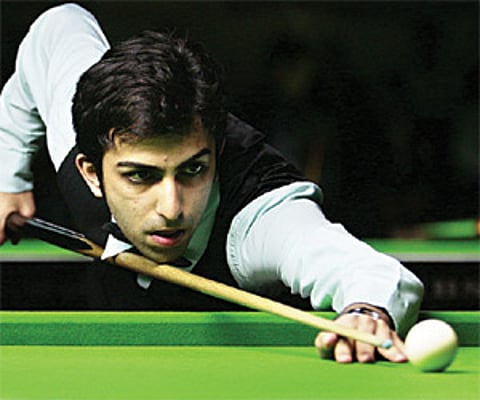
Pankaj Advani, winner of the world pro billiards crown, has won everything there is to win in that cue sport. As of now, he has no plans to play in the world pro snooker circuit just as he has no intention of relaxing his grip on the billiards titles to his name. Excerpts from an interview…
Is winning a habit now?
Well, I just go out and enjoy playing and don’t think of the result. I believe that if you play to your potential, results will follow.
How do you approach a major tournament?
I never go out with the intention of winning the title. Nor do I worry about my opponents. I just go out and play and focus on enjoying my game.
You won the world pro billiards title on your third attempt. What went right this time?
Yes, I had lost twice earlier and that could have happened this time too. I was in a tough group and lost to Dhruv Sitwala. I had to beat Geet Sethi to stay in contention and I managed to do that.
Did playing nine-time Mike Russell in the final make you apprehensive?
I did have some worries and discussed my game with my friend Bhaskar, who asked me to follow my natural style rather than making specific plans for Russell. This piece of advice helped me relax and gave me confidence.
You didn’t have a plan?
There was a plan — a simple plan. Russell is a slow starter; once he gets going, it is extremely difficult to catch him. So it was important for me to take a big lead early on and put him under pressure. I managed to do that by notching up big breaks consistently. Eventually, this strategy helped me win.
When Russell won his first pro title in 1989, you were four years old. Now that you have beaten him for your first pro title, how does it feel?
Russell is the best exponent of billiards in the modern era and defeating him, that too in England on the very table on which he has won so many titles, feels great.
Which of your world titles do you cherish the most?
I have won seven world titles and all of them are equally important.
What is your next goal?
I will keep playing and pick up whatever title comes my way.
What of crowns you have not won like the Asian snooker title? And what of entering the pro snooker circuit?
I can’t possibly win all the titles on offer. Yes, I will definitely try to win the Asian snooker title, but I don’t want to play in the world pro snooker circuit.
Any particular reason?
Playing in the world pro circuit means that I will have to play snooker for nine months a year. Then, I won’t be able to play billiards and I don’t want to stop playing billiards. Also, turning pro would require me to relocate to England and I can’t do that right now.
You say that you have silenced your critics. What exactly do you mean by that?
Now that I have claimed the world pro billiards crown, nobody can say I have not won a pro title.
Geet Sethi has won the World Pro Billiards title 6 times. Do you feel you can better this feat?
Geet is a great player. Moreover, it is not right to compare players of two different generations. I respect Geet and his achievements. It feels great when I play against him. Winning or losing is not important when talking of Geet. That he is around even now proves his calibre.
Do you plan to set up a coaching programme for youngsters?
I am a student of the game and still learning. In future I will think of a coaching programme and give something back to the sport that has given me everything.
How would assess India’s standing in international sport?
We have a long way to go. Until there are 10 Abhinav Bindras, 10 Saina Nehwals and 10 Vijender Singhs, we can’t claim to have made significant progress. The odd champion here and there is not a sign of progress. We need to develop a sports culture in our country; only then can we expect more success.
shreekumars@hotmail.com