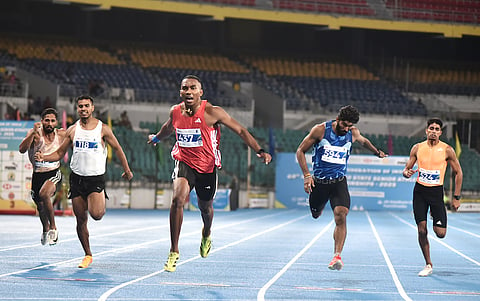

CHENNAI: A total of 194 athletes in history have achieved that magical milestone of dipping below 10 seconds in the 100m sprint, sport in its purest adrenaline-filled form. Theatre on track.
Since 2021, athletes from Sri Lanka, China, Cameroon, Ghana and Botswana, countries with not a lot of sprinting heritage, have managed to breach the promised land. You can possibly put this down to a marriage between cutting-edge training, sports science, shoe tech and a better understanding of human physiology.
For a long time, Asian athletes were, on average, too slow in the quickest events. In competitions where fractions are the difference between first and last, they tended to lose out.
That is changing. Only nine Asians have dipped below 10 seconds in the history of the 100m — seven of those did that for the first time in or after 2015. It's not immediately visible but change is afoot in India's own 100m programme. For a long time, Amiya Kumar Mallick's 10.26 second 100m run was the gold standard. Set in New Delhi in 2016, it had eclipsed Anil Kumar's mark of 10.3, set in 2005.
It took 11 years for one athlete to lower the mark by 0.04 seconds.

There's now a band of Indians threatening to breach the 10.15 second mark. In 2022, Amlan Borgohain set a time of 10.25 seconds. Manikanta Hoblidhar responded with a 10.22 in 2025. On the same day and track, Gurindervir Singh's 10.20 set a new standard. A couple of months later, on July 5, Animesh Kujur, Indian athletics' latest poster boy on track, set a new national record of 10.18.
Three years, four athletes and bringing down the mark by 0.08 seconds. There are others, too. In Chennai at the ongoing national inter-state, S Tamilarasu clocked 10.22 seconds, the fourth fastest Indian ever. He’s of the belief that he can, in the future, bring that down even further.
In the world of elite sport, change can often be non-linear and the pace of said change can be glacial but that’s how marginal increments work.
The margins currently being knocked off can be traced back to when James Hillier entered India’s athletics programme in 2019. “I think you got to go right back to the start,” Hillier, who used to work with England Athletics, tells this daily. “When we started this project in 2019, what were our goals? It was to professionalise athletics in India. Our goals were to bring in high levels of technical expertise. When I first came to India, everyone said ‘Indian athletes can’t do that, they can’t do this. I used to always question that narrative. Why can’t we? I think 6 per cent of 1.4 billion Indians have access to track, it’s still a huge number.”
One of the things he changed immediately was to challenge belief systems but he made it a point to embrace Indian culture. “What you are seeing is the result of Martin (Owens; Kujur works with him in Bhubaneswar),” he says. “Now we are getting athletes we don’t even coach that are doing well. Because we have directly impacted the whole ecosystem.”
In the last two years alone, Indian athletes have set new benchmarks in both sprints, the men’s four by one as well as the two high hurdles.
*** *** ***
When Hillier walked into the sprint programme, he found out that Borgohain was doing two sessions a day, six days a week. It was an immediate culture shock for the athletics director at Reliance Foundation. He worked on modifying athletes’ training loads and inculcated in them the value of good night’s sleep.
“You don’t need to train twice a day,” he says. “The athlete improves when they rest and recover, when do they do that? When they sleep. You improve when you are sleeping and resting.”
Both Hillier and Owens, chief coach at the Reliance High Performance Centre in Odisha, spoke about ‘the culture of twice a day’ in India and why that’s against science. “Training loads are based on science,” Hillier says. “You got to trust it. For somebody to come and say ‘your speed session is four 80m runs’, people can’t cope with that. Trust me, if you are going fast, that’s enough. No need to do anymore.”
Both coaches had an in because the athletes bought into the system. “It’s about trying to create an athlete to be the best they can,” Owens says. “That’s not just about lifting more weights or running faster on the track. It’s about everything. If they start doing everything a little bit better, the improvement will come. If they don’t buy into that, there’s nothing you can do.”
While both Owens and Hillier, the coach who has made Jyothi Yarraji a national treasure in the women’s high hurdles, say India are blessed with world-class facilities, it’s about putting in place belief systems, building up confidence, giving athletes international exposure and lots of positive vibes.
The following example may well be from the Ted Lasso universe but the duo have stuck motivational posters around the Stadium to drive home that point. One of the posters reminds them that the one most likely to win is the best prepared athlete.
It’s also kind of why there’s a fine for anybody who utters the word ‘rehab’. “It’s a terrible word,” Hillier says. “Anybody who uses the word gets fined `500. We use exercises or conditioning. “It’s all about how you frame things. If you are in a positive mindset, the bullet will bounce off you. If you are in a negative mindset, the bullet will go straight through you.”
*** *** ***
Among relays, the four by one has its own pride of place. It’s 40 seconds – give or take a few – of undistilled sport. From an Indian perspective, though, the sprint relay was kind of overlooked because the Athletics Federation of India (AFI) focused more on the four by four. To be fair to them, they had the runners to last the distance and the continental and Commonwealth medals were proof.
But Hillier and Owens wanted the Federation to believe in the shorter of the two relays. The penny dropped at the Relay Carnival in Chandigarh when the quartet of Kujur, Borgohain, Singh and Hoblidhar broke the relay record in April. “They are,” Hillier says, the pride unmistakable in his voice, “statistically the best relay team in the country and it’s not even close. They (AFI) were investing everything into the four by four. Now, they have no choice but to invest in the four by one.”
The Asian Games is the one place where India’s relay teams have returned with shiny metal discs of varying colours tucked in their suitcases. The AFI may be expecting a similar prize when they go to Tokyo in 2026. This time, however, they may be waiting for the men’s four by one to deliver.
The challenge, though, is going to be big. Forget medalling, they have taken part only twice at the Asiad this century.