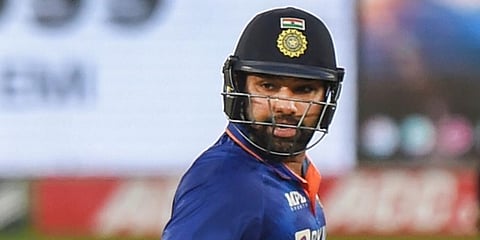

CHENNAI: The last time India fielded Shikhar Dhawan, Rohit Sharma, Virat Kohli, and Jasprit Bumrah in the same ODI, the world was yet to be shaken up by Covid-19. There is a strong chance that the wait will continue especially given the injury scare to Kohli, but this just shows where India stand 15 months ahead of the next 50-over World Cup.
In many ways, India’s ODI game has revolved around these three in the batting. Like it was the case in the T20Is, they have been heavily relied on their top three that they have even made KL Rahul – missing this series with an injury – bat in the middle-order. But all of it is in the past. They have pressed reboot in white-ball cricket and with the T20 side embracing an attacking approach, the series against England is an ideal opportunity to see how far they can adapt the same in ODIs.
Unlike in T20Is, where they brought in new personnel, the selectors haven’t shown as much intent with their selection. At the top, at least for the time being, they continue to believe in the Dhawan-Rohit combination that has scored 5186 runs at a run-rate of 5.31 at an average of 45.49. They are easily one of the most efficient opening pairs in the last decade, but the question is does that run-rate belong to the current era. To put things in context, Virender Sehwag-Sachin Tendulkar combination that batted between 2002-2011 had a run-rate of 6.16 at an average of 42.13. Even the Gautam Gambhir-Sehwag pair scored at 6.42.
With the next World Cup to be played in home conditions, where flat decks will be the norm, the question is whether India have the right personnel to make optimum use of the conditions. It is not that India don’t have other options. With Rohit’s place all but locked and Prithvi Shaw and Ishan Kishan available as options, it would be interesting to see how far India persists with Dhawan. “For us, the aim is to understand white-ball cricket, how to play, new guys are playing. Fifty-overs is an extension of T20. Maybe you take less risk in ODIs as compared to T20 cricket but you have to take it. We can’t play thinking ODIs are not a priority,” skipper Rohit said.
As has been the case in T20Is, the middle-order has been a huge cause of concern for India in the ODIs with the team entering two successive World Cups in 2015 and 2019 without a designated No 4. While India have been looking at Shreyas Iyer as an option, in Suryakumar Yadav and Rishabh Pant, they also have the sort of enforcers they have been badly missing in the format off-late.
For a side that has largely preferred to prweserve wickets and go big in the last 10 overs, at some point they will be forced to change the strategy and as Rohit mentioned, it appears India will now treat ODIs as an extension of T20s. In terms of conditions, they may be get the ideal ones in UK to try the template.