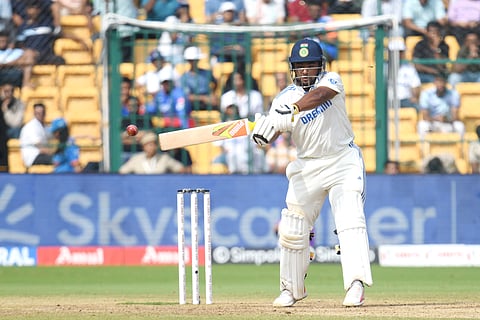

BENGALURU: When Sarfaraz Khan wanted to flay the second new ball through point minutes after New Zealand had taken it in the third innings, Rishabh Pant, the man at the other end, marched up to offer a few words of advice. Within the context of the situation, Pant, perhaps, did the right thing. The strip was a new ball one; there was always seam movement and the hosts only had 50 runs in the bank to play with it at the stage.
However, pull the curtain back a little and it's fairly obvious that Sarfaraz's shot, in a microcosm, is the new Indian way.
Keep attacking with the bat, set the tempo. There has never been a readily identifiable Indian DNA with the bat but this is probably the new regime's one big early change. It's why captain Rohit Sharma and coach Gautam Gambhir have already used the word freedom multiple times within the batting framework of the Test team.
"When the guys are showing that kind of attitude on the field with the bat, it shows that the mindset is clear," Sharma said of India's response in the second innings.
"The guys want to go out there and play with freedom and try and see how we can put the pressure back on the opposition."
When the hosts began their response to New Zealand's 402, they were 356 in arrears. However, for vast stages, it didn't feel like that. The Kiwis had to adapt quickly; they had a sweeper cover and their spinners couldn't build pressure by having men around the bat.
"... in the second innings with the bat, to come out and play like that, it felt like we were ahead in the game at one stage," Sharma added. "We didn't feel like we were 350 behind and that is something that I'm really proud of."
It's a byproduct of moving on from the likes of Cheteshwar Pujara, Ajinkya Rahane and Wriddhiman Saha and bringing in place the likes of Shubman Gill, Sarfaraz Khan, Yashasvi Jaiswal and Rishabh Pant over the last three years or so.
Pujara (49.3 per cent of his total runs in boundaries), Rahane (49.67) and Saha (44.34) were perfectly capable bats. They have won games for India but this generation has their own ways and means when it comes to batsmanship.
All three of Gill (55.1), Jaiswal (61.3) and Pant (58) scored a higher percentage of their runs in boundaries. It's what works best for them and the support staff have to be celebrated for providing the keys and unshackling them
In the same vein, they will also have to accept that this new found methodology can be counter-productive. There will be batting collapses as batters try to set the agenda. To be fair to both Gambhir and Sharma, they have done that.
Speaking before the first Test against the Black Caps, Gambhir had said: "... there will be days when we will get bundled for 100 and we will take it up. If they can play the natural game, if they can get 400-500 runs in a day, why not? I have always maintained that cricket has to be played that way. And we will play it that way. High risk, high reward, high risk, high failure."
While some of these stats go back to when Rahul Dravid was still the chief coach, no team has scored as many sixes in Tests since the beginning of this year. It stands at 107, 39 clear of England. It's the same when you want to consider strike-rates.
For example, in 2022, India scored 57 runs per every 100 balls their batters faced. In 2024, that number stands at 61. Under Gambhir - granted three is very few numbers to draw a conclusion - it's 73.
Sharma, if anything, was unequivocal about the side's desires. "When we are behind the game, that is where you want to press your pedal even more and try to make an impact," he said.
"Try to not let the opposition know that we are under pressure or we are behind the game. When you are actually behind, you want to try and do extraordinary things and play without any fear. It's one thing to talk about it, but actually we went out there and played some fearless cricket."
They aren't trying to reinvent the wheel or anything; to be honest, they aren't claiming it. What this new system aims to do is encourage the batters coming through the system with a style and grammar of play they are familiar with.
Will it pay dividends? A low, slow black soil Pune wicket and a red soil wicket in Mumbai over the next few weeks will offer immediate challenges. The bigger challenge, though, awaits them in Australia.
No of 6s hit in 2024
India 107
England 68
New Zealand 64
India S/R in the last three years
2022 57.72
2023 53.21
2024* 61.29
* till Oct 20
India's last three Tests (since Gautam Gambhir was appointed coach) 73.24
India's RPO in Tests since 2020
2020 4 2.77
2021 14 3.01
2022 7 3.72
2023 8 3.36
2024 9 3.83
