
VISAKHAPATNAM: For a while, on a tense Tuesday night at the ACA Stadium in Guwahati, Nigar Sultana’s Bangladesh had England on the ropes. Chasing 179, the Nat Sciver-Brunt-led side were reduced to 66/5 first before going six down for 103. If not for Heather Knight’s patience, along with Charlie Dean, a truckload of luck for England, Bangladesh could have just caused the biggest upset of this World Cup.
Knight and Dean rode their luck, kept their cool before taking England home in the 47th over of the innings. Credit has to be given to Bangladesh bowlers — led by a young pace sensation in Marufa Akter and Fatima Khatun — for putting up a valiant fight and pushing England to the edge. However, it would not have been possible without the unbeaten 43 of 27 in the end from Rabeya Khan. The 20-year-old all-rounder came in to bat at No 9 with the scoreboard reading 130/7 after 43 overs. After what seemed like a long lull where Bangladesh batted themselves into a shell — it seemed like there was no chance of them coming out of it — Rabeya came out like a breath of fresh air.
On the first ball she faced, Rabeya got on one knee and slog swept Alice Capsey to the ropes. She repeated it two balls later and fetched the same result. And it was not like she was trying to go big every delivery; Rabeya played out Sophie Ecclestone’s over without much risk before getting under Linsey Smith and tonking her down the ground. The 20-year-old farmed the strike as much as she could, watched her team lose two more, but that did not stop her. Rabeya scooped Capsey, sent Smith over the sightscreen for a six before sweeping her again. She remained not out as her team was bundled out for 178. It was an innings that perhaps came a little too late, but gave Bangladesh a fighting chance.
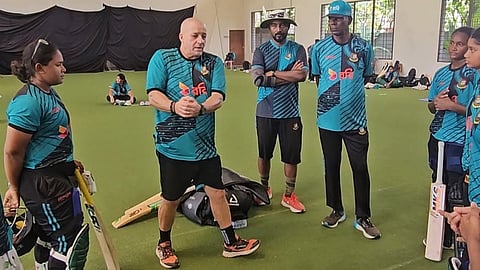
Rabeya is among the next-gen stars coming up the ranks in Bangladesh. She was a part of the 2023 U19 Women’s T20 World Cup squad along with Sumaiya Akter, Shorna Akter and Marufa. The four of them are now with the senior team, playing their first ODI World Cup. Rabeya showed that she has the skills and the power to clear the boundary and take on bowlers at will. It is something she and the entire Bangladesh team worked with power hitting coach Julian Wood, who spent a month in the country working with the men, women and the coaches. Wood, in a conversation with this daily, breaks down how the first step was about making the players aware of what they are doing and how they have the power to do so much more.
“If you looked at the stats of the top three teams, like England, India, Australia, I obviously looked at strike rate, attacking ball percentage, control of those shots, of the attacking shots percentage and boundary percentage. Obviously, the big three are miles ahead of anyone else. Once you have got a bit of data, then there's proof there to the players that this is what we need to do,” Wood explains. Once the areas where they need to work on are laid out, the next step is showing them that they do have the power.

“They are very good players, they're technically good. There's a myth that's been going around for years, that the likes of Bangladesh don't have power. But they're technically good. They have enough power, they just need access to it. It was giving them the tools, giving them the understanding of how to access that power and creating more scoring options,” says Wood. “The girls have good foundations. Now, we've got to put layers on top of that. When you bat, you tend to lead with your head. When you hit, you tend to lead with your hip. It's just giving them space. Everybody talks about hand speed, but if you get too close to the ball, your hands can't accelerate through the ball. So, the way your hands accelerate through the ball is with space. If they have space, then they can accelerate. But you don't want to be too far away from the ball. So, there's the optimal distance. But the key thing for me was just different ways of doing things and different ways of accessing what they've got, really and giving them more. The more options you have, the less panic you see when you play,” says Wood, before adding, “A lot of these bowlers, especially the seamers, a lot of the seamers will just bang it onto that length. They (batters) are all technically good, but you can move. You don't have to stay in the same position. You can go up in the crease. You can go out of the crease. You can go deeper in the crease. You can go sideways as well. So, you start to create scoring opportunities. It's just giving them that freedom to allow them to do that, rather than just staying in one place and just being dictated to by the bowler.”
While glimpses of the results are there to see with Sobhana Mostary’s cameo against Pakistan and Rabeya versus England, there is still a lot more progress to be made. Bangladesh played more than 200 dot balls against England on Tuesday, especially Shorna, Fahima and Ritu Moni going into a shell. Wood feels the younger players brought up on T20 cricket, while the seniors are trying to break the template that has been ingrained in them for years. “In 50-over cricket, you still need players who can hold the innings together. There is a place for that in this format and the women’s game. But you also need a sort of new dimension of a cricketer. The young players coming through, obviously, they're going to be nervous. But you've got to trust them. You've got to trust the process,” he says. And the process takes time.
Understandably, Bangladesh have a long road ahead, but the two matches and the next generation of players have shown that they are on the right path. And more importantly, they have the will to change and upskill themselves to be among the best in the world.