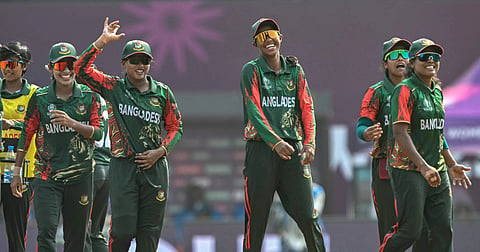

NAVI MUMBAI: When Bangladesh women were granted ODI status by the International Cricket Council (ICC) on November 26, 2011, it was a recognition of the efforts put in by the players and their consistent performances. However, that did not automatically translate into more matches and exposure.
From 2011 to the 2022 ODI World Cup in New Zealand, they got to play only 42 games, which pales in comparison to the top eight teams. Five of them, including India, had played more than 100 ODIs, and the other three had over 70. It all changed when they qualified for the ICC Women’s Championship. It was based on rankings, as the 2021 World Cup Qualifiers were cancelled midway due to COVID.
Inducted in 2014 to guarantee more bilateral matches with added context, the ICC Women’s Championship ensures each team plays at least 24 games in a World Cup cycle. It is also used as a pathway for teams to directly qualify for the blue-riband event. The 2014-17 event featured eight teams, with three directly qualifying for the WC in England. In 2017-21, the top four and hosts New Zealand qualified from the eight before ICC increased the number of teams to ten, including Bangladesh, who also qualified for the WC based on rankings ahead of Sri Lanka, and Ireland.
While Australia have won every single edition since its inception, the Championship has made a drastic difference for the two lower-ranked teams. Since March 2022, Bangladesh have played almost as many ODIs as they did between 2011-2021 — 41 (till Saturday). They toured New Zealand for the first time ever in 2022, thanks to the Future Tours Programme (FTP), which ensures that the bigger boards host the teams who are striving for opportunities.
And no one knows it better than Bangladesh batter Fargana Hoque Pinky. “This is very important because the points you get here will help you qualify for World Cups directly,” Pinky told this daily. Qualifying for the 2022 WC in New Zealand became an eye-opener for her and the team, as they had never experienced it before — to play in an ODI multi-nation tournament against top teams.
During the 2022-25 cycle, Bangladesh played 28 games in comparison to the 11 bilaterals they played between 2017-21. “These 25-26 matches we played gave us a huge experience. I think in our next cycle, we will start from India, our first match (2025-29). It gives us a chance to show the world how far we have come, the Bangladesh team. When FTP matches come along, everyone is interested because of the WC qualification. Everyone wants to give their best. Going forward, it will do a lot of good for the team,” Pinky says with hope, talking about the 27 bilateral matches they will play till the 2029 World Cup.
During the upcoming cycle, they will get to play bilaterals in England and Australia for the first time. And it is not just Bangladesh and Ireland, last year, the ICC also included Zimbabwe with the Women’s Championship expanding to 11 teams. The 2029 World Cup will also see the number of teams increase to ten from the current eight.
At a time when the women's game is seeing a rapid rise, the expansion of the Championship and its existence are pivotal to the growth of the sport in countries that do not have the finances of the top teams. The road ahead looks greener and brighter.
