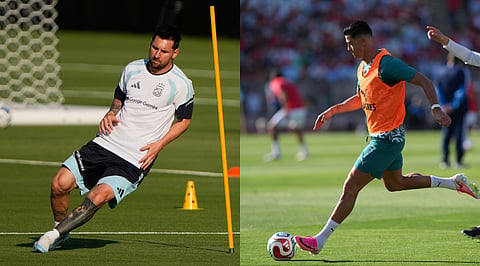

DO you consider yourself a liberal? Chances are, you prefer Lionel Messi over Cristiano Ronaldo. Conversely, if you are more of a conservative, you would generally plump for Ronaldo over Messi in all debates.
This is according to a first-of-its-kind study conducted by a team led by professor Saifuddin Ahmed, a faculty at NTU's Wee Kim Wee School of Communication in Singapore. The international survey of more than 10661 respondents in 26 countries (India leans towards Ronaldo according to the findings) was published on the university's website on Friday.
Ahmed spoke to this daily on the method used, what was the inspiration behind undertaking such a niche study, how he interprets the India numbers and the significance of Spain preferring Messi over Ronaldo, a country where both players spent their best years in at the same time. Excerpts:
On the reasoning behind this study
It started with a simple observation: the Messi-Ronaldo debate is one of the few arguments that happens in virtually every country on earth, across languages, cultures and political systems. But when you look closely at who takes which side, it stops feeling random. The two players have become vessels for something beyond football. Messi represents a certain kind of quiet, collective excellence; Ronaldo represents individual dominance and openly declared ambition. Those aren't just aesthetic preferences. They map onto value orientations that also happen to organise political life.
That pattern was noticeable anecdotally, but anecdote isn't evidence. The scientific question was whether it would hold up under rigorous cross-national testing and whether it was specifically political identity doing the work, rather than age, gender, nationality or any number of other factors. The Messi-Ronaldo rivalry is almost uniquely suited to that test because the two players are so comparably accomplished that you can't explain preference through objective performance differences. What's left is what people project onto them, and that projection, it turns out, is partly political.
The World Cup provided both the motivation and the moment. With football at the centre of global attention, it seemed the right time to ask what the world's most argued-about sporting debate actually reveals about the people having it.
On the method used and what the India numbers reveal
The study uses regression modelling rather than simple counts, so reporting raw headcounts of "X preferred Ronaldo, Y preferred Messi" would actually be misleading. The meaningful finding is about the relationship between psychological variables and preference. What the data tell us is that within every country surveyed, respondents who lean more conservative than their compatriots tend to rate Ronaldo higher, and those who lean more liberal tend to rate Messi higher. Reducing that to a headcount loses the finding entirely.
On India specifically, the result cuts against all that Messi fervour you might expect. Surveyed properly, it's Ronaldo who edges it here and a slight but statistically real lean, and one that barely moves whether you cut the sample by age or gender. India tilts Ronaldo, quietly but consistently. It also sits toward the higher end of short-form video news consumption in our sample, which independently predicts Ronaldo preference across the full dataset that is consistent with Ronaldo's extraordinary reach on platforms like Instagram. It's one of eleven countries where Ronaldo leads but given the noise around Messi's popularity in South Asia, the consistency of the India finding is worth noting.
On would it be safe to say countries that identify themselves as first world or where democracies are strong have preferred Messi and most third world countries have gone for Ronaldo?
There's a genuine pattern in the data worth discussing, but the first world/third world framing isn't quite right, and I'd be cautious about it. What we actually find is that the V-Dem Liberal Democracy Index, a rigorous institutional measure of civil liberties and democratic governance, shows a consistent directional association with Messi preference at the country level. More democratically consolidated societies tend to lean Messi; less consolidated ones tend to lean Ronaldo. That's an institutionally grounded finding.
What it isn't is a development story. "First world" bundles together democracy, wealth and a set of cultural assumptions that don't all travel together in our data. France, for instance, is by any measure a wealthy liberal democracy and it leans Ronaldo. Brazil is neither poor nor undemocratic, and it's effectively split. The democracy effect is real but modest, and it doesn't map cleanly onto a rich-poor or developed-developing axis.
There's also an important statistical caveat, with only 26 countries, the country-level analysis is underpowered, and the democracy finding sits just outside conventional significance thresholds. It's a consistent signal worth taking seriously, but we'd want more countries before treating it as a firm conclusion. What I'd say is this democratic institutional context appears to matter, but the story is more nuanced than a first-world versus third-world divide.
On is it surprising that England, where Ronaldo has spent a significant time in, has gone for Messi. And, Spain, where both players spent a good chunk of their careers in, also went for Messi
Surprising at first glance, but actually quite interpretable once you look at the data carefully. The key thing to understand is that our measure isn't raw popularity, it's a relative preference score, Ronaldo's rating minus Messi's. Both players are rated warmly in England and Spain; what tips the scale is which one edges ahead.
In England's case, Ronaldo's time at Manchester United, two separate stints, enormous commercial presence, genuine affection from United supporters, clearly left a mark. But Ronaldo's relationship with England has never been entirely straightforward either. English football fans have a long memory and his relationship with the British press has been complicated at times, the Rooney wink at the 2006 World Cup being perhaps the most iconic illustration of that ambivalence. Whether moments like that leave a lasting imprint on public sentiment is difficult to test directly, but it speaks to a broader pattern: Ronaldo's openly individualist, self-promotional persona tends to get a more mixed reception in British media culture than it does elsewhere. Our data suggest that in that environment, the more understated, team-first qualities associated with Messi resonate slightly more broadly across the population. It's a small lean, not a landslide.
Spain is perhaps even more telling. Both players defined Spanish football's golden era, Ronaldo at Real Madrid, Messi at Barcelona, and the rivalry between those clubs maps the country's own deep cultural and regional fault lines. You might expect that to produce a split. What we find instead is a modest but consistent Messi preference, which may reflect the fact that Barcelona's collective, possession-based identity, with which Messi became synonymous, resonates with Spanish footballing values more broadly than Ronaldo's individual brilliance does. The Clásico rivalry runs deep, but when Spaniards are asked to choose between the two men rather than the two clubs, Messi edges it.
(The study is currently under peer review for publication in a scientific journal)
Pre-print of the findings can be found in this page --
https://www.ntu.edu.sg/media/docs/default-source/corporate-ntu/hub-news/messi-or-ronaldo-your-political-ideology-may-be-linked-to-the-answer-ntu-singapore-led-international-survey-finds.pdf?sfvrsn=2e8c784c_1
