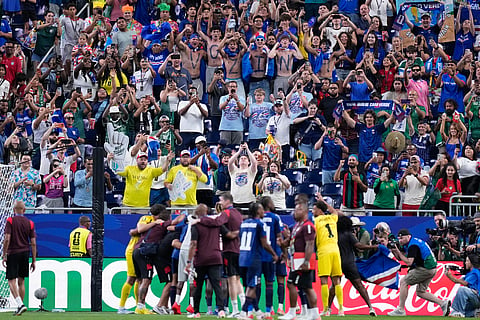

WHEN Cape Verde's greatest songs are written, there will be more than a few dedicated to the night when their football team provided joy for millions across the globe. Forget the fact that the small archipelago of islands off the west coast of Africa have a little over five lakh inhabitants. Millions of football fans will happily wear the colours of their national team in the stands from now till eternity.
Even watching from afar, over 15,000 kms to be precise, it was impossible not to fall in love with the country's football team and its people. Over the last two weeks, they have reminded the world why sport mattered, and will continue to matter, to a lot of people. They used a heaving Houston Stadium on Friday as the canvas to write not only one of the greatest World Cup stories but also one of the greatest sporting stories of all time.
That sentence has already been written many times over the last two weeks, but that shouldn't be a reason to stop writing it because it's still ludicrous to even think about it. A population of just over 5,00,000, a small group of islands, most of them semi-professionals... even the idea of them at the World Cup beggared belief. On Friday night, this team wrote another epic as they advanced to the knockout stages to likely face Lionel Messi and Argentina. Come on.
****
As soon as the whistle cut through the Houston night sky, the celebrations had already begun in the stands. Ana Candida Evora, Vozinha's mother, was dancing with others. Strangers were hugging each other as the electronic scoreboard in the stadium read out: Cape Verde 0-0 Saudi Arabia.
On the field, though, the celebrations were paused. The players huddled around a few mobile phones as they were tracking the second-by-second updates of the other match in the group between Uruguay and Spain. The latter were leading 1-0; as long as it stayed that way, Cape Verde would go through.
As the play went deep into injury time in Guadalajara, some 1400 kms in a neighbouring country, some of the players couldn't bear to watch it anymore. They turned away and started looking at the crowd for some visual cues. The braver players were transfixed, like in a trance. Surely, the referee should have blown the whistle by now? At long last, after what seemed to be an age, news had filtered through to the players that Spain had won 1-0. Uruguay were out. Cape Verde would be advancing to the Round of 32.
At that exact point in time, the smiles on the players' faces returned. They were all grinning from ear to ear; some had taken off, not knowing what to do in that moment of ecstasy. A few fans in the stands had started to cry. Fifty-one years after independence, this was undoubtedly their biggest sporting moment to date.
When they had qualified to the World Cup, the cynics had said it was only because of the expanded 48-team event (spoiler: it wasn't; they topped a group containing Cameroon). At the World Cup, they have become one of the stories of the whole thing.
****
Somewhere in that huddle was Roberto 'Pico' Lopes, an Irish ex-banker of Cape Verdean descent who gave up a career in banking because Shamrock Rovers offered him a life in football. He took it in 2017 not knowing if he was doing the right thing. Who writes these things?
Lost in the melee was Vozinha, the 40-year-old goalkeeper who turned professional at 25. At the World Cup, he already has two clean sheets. On Instagram, he has over 15mn followers (he had fewer than 100,000 when he came to the US three weeks ago). He was upset that his mom wasn't there to watch him keep out Spain. On Friday night, she was there to see him play a part in their night of nights.
Ryan Mendes perhaps had a phone with him, trying to capture these moments for posterity. On his 101st cap, 16 years after his first, the captain had led this team to a place none of them would have experienced before, even in their dreams.
When Kevin Pina was growing up in the US, he wouldn't have even dreamt of football for Cape Verde, let alone playing in a stage like this. But a former captain, Carlos Morais, saw him on the streets of Massachusetts and convinced his father to make the move across the Atlantic. But there, Benfica rejected him. So Pina worked extra hard. This was a million-to-one Hail Mary moonshot. But all he wanted was a moonshot. Just like Cape Verde.
Perhaps, it was meant to be. Morais scored the country's first-ever goal in a World Cup qualifier in 2003 against Swaziland. In the US, Pina scored their first-ever goal at the World Cup.
Who writes these things?
