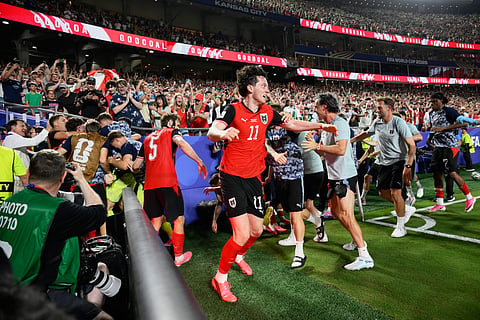

When injury time began in Kansas on a fever-dream kind of Saturday night, both teams were fairly content to knock it about. The match itself had been thrilling for the first hour before both Austria and Algeria seemingly decided to lessen the intensity and not risk. The result — a draw — suited them both.
In Tijuana, Mexico, the 26 Iranian players and support staff, would have doubtlessly huddled next to a TV set, wanting a win for either team. The equation for Iran to get through was simple. There had to be a winner. If this were a draw, Iran would have to go home.
For a period of time, it seemed like Austria would win. Twice, they took the lead. Twice, Algeria had come from behind.
Before this Group J match began, the mind went back to 'The Disgrace of Gijon', a league stage encounter at the 1982 World Cup. West Germany and Austria played safe in the knowledge that a 1-0 to the former would send both of them through at Algeria's expense. Even 42 years later, allegations of collusion refuse to die away (it's why the final matches within all groups start at the same time).
In the days leading up to the fixture in Kansas, a few fans had already started expecting the worst. "Disgrace of Kansas," a few started calling it. And for the vast majority of the last 30 minutes, it seemed like there was some unwritten gentlemen's agreement in play. You don't try to score. We will not try to score.
Some sections in the crowd had started booing. The Algerian defenders were just knocking the ball between themselves while the Austrians kind of stopped moving.
Then, three minutes into injury time, Riyad Mahrez scored.
There was pandemonium among the Algerians in the crowd. There was shock when the camera showed the Austrian fans. Wait? What happened? Even the commentators on air were struggling to come to grips with what they had just seen. A match ambling towards a logical finish had just lobbed a grenade.
Two minutes after the goal, the Austrians turned to Sasa Kalajdzic, the 28-year-old striker on loan at LASK. A centre-forward, Kalajdzic stands at over 6'6". His introduction signalled only one thing. The Europeans were going to get it into the mixer in the hope of mustering a positive response with a minute or so remaining.
A cross from the left wing sailed over the six-yard box, evaded the defender but Michael Gregoritsch had gambled and he was waiting at the back post. His cushioned header was pin-point and the onrushing Kalajdzic headed it home to spark scenes of delirium wherever you looked. The Austrian fans, some of whom had given up hope only minutes earlier, embraced life again. On the field, there were limbs everywhere. The players were running in all directions not really knowing what they were doing; usually a good indicator of madness on a sporting field.
It was one of the wildest endings to the group stages of any World Cup down to the identity of one of the main protagonists of the final act: Kalajdzic. He had suffered three Anterior Cruciate Ligament injuries between July 2019 and February 2024. His last ACL injury was so severe he had missed all competitive football for over 425 days from February 2024 to April 2025. On Saturday night in the din of Kansas, he finally had a moment to remember.
In Tijuana, it would have been a moment to forget for the Iranian team.
