
SINGAPORE: There's a photo of Magnus Carlsen immediately after the World Championship he won in 2021. In the image, there's a chessboard with pieces and the trophy to its left in the foreground, with the Norwegian all smiles in the background. It's one of Niki Riga's favourite clicks.
To the average sports fan accustomed to sports images being full of action, this particular image may not seem all that arresting. To Riga, it means the world. "It isn't artistic or anything but I'm the only one who has it," she says. Riga and a select few have one of the toughest jobs in elite chess. Chess photography.
There's a mantra David Llada, one of the foremost chess photographers in the world today, swears by. "I always say the easiest part of chess photography is that your subject doesn't move," Llada, who, like Riga and many others, is in the city-state for the ongoing World Championship between D Gukesh and Ding Liren, tells this daily. "But the difficult part is that the subject doesn't move. That doesn't give you many opportunities to get a good shot."
When you think of images in sports, you think of vibrant photographs rich in colour, action, detail and life. That may not necessarily be possible in chess, especially at the World Championship because there are just two players, one chessboard (most other top-level events like the Olympiad or the Candidates are held in convention centres), a table and not enough movement. The one between Liren and Gukesh, for example, is being held in a large room, colloquially known as a fish tank.
So how do you ensure your photographs stand out in the papers and websites? "It's completely different from any other kind of sports photography I know," Llada says. "Everything that happens after and before the game is the same; you have the press conferences. But the game of chess (to capture) is very different. It's similar to portraits (images). There is body language, but it's very subtle. You focus on the face, the hands, the expressions... the kind of things you do in portraits."
That is one of the many quirks of photographing chess players in action. Unlike most other sports, it genuinely helps to know if you play the game. Both Llada (Classical rating of 1938 according to FIDE) and Riga (1717) have a basic understanding of the game. They know when a 'moment' is around the corner. It's crucial to have this nuance in chess. In football, tennis or cricket, the moment is pre-advertised. In this game? Not so much.
Here's Llada. " You see this moment coming in football or tennis," the former chess journalist says. "It's not so obvious here. You need to follow. There's going to be a moment when the player is going to do something, like seeing his opponent or a gesture or something. You need to be prepared for that. It may last a few seconds in a game lasting over 4-5-6 hours. You have to grab that opportunity because you won't get many chances to do so."
Riga, who works in FIDE's social media team, agrees. She calls it the 'gift'. "For me, chess photography is all about the emotions and catching the eyes," she says. "I know it's very still energetic at the same time. There's action in stillness. I feel the action. I am not the greatest player but I understand it."
Lennart Ootes (Classical rating 2115) concurs with both Llada and Riga. It helps to know the game. "I try to think like a journalist," he says. "I'm a chess player, I like the game. I try to predict interesting and important matches to cover. I want to capture a story through my lens so I'm trying to look for those moments which might be deciding the tournament."
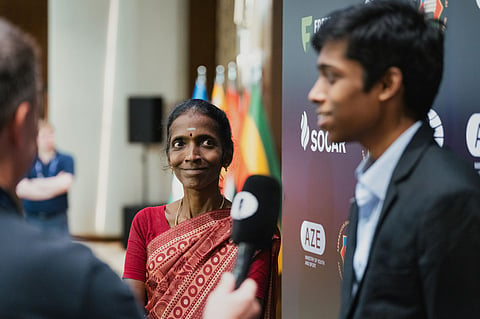
The kind of photo Ootes, who's helping with the broadcast in Singapore, likes is that of parents or coaches meeting the players immediately after a game. You can see Ootes' perspective. One of the viral sports images — chess or otherwise — of 2023 was Praggnanadhaa with his mother, Nagalakshmi. It was clicked by Maria Emilianova immediately after her son had advanced to the World Cup final. Emilianova had blurred Praggnanadhaa and focused on a beaming Nagalakshmi in the background.
It is the point Riga makes. "It's all about the eyes."
Some sports images lend themselves to noise because of the setting it's shot in. Chess? Nada.
"My cameras have never seen daylight," Ootes laughs. "It's always in hotel ballrooms or fish tanks. The environment is dark and there's hardly any moment. In the most important moment, there are some handshakes and a very quick show of emotions. You are always working with limited light so it means you are fighting with your camera against the impossible. In other sports also, you are trying to capture moments but you have more light to work with. In chess, it's a lot more challenging."
While Ootes gives a lesson on how the basics of taking a picture are universal, 'I like to keep my camera low to have better focus on the eyes as the eyes of the chess player are looking down. If you want to capture the eyes, you have to lower your cameras.'
Llada explains. "They say that when you are taking photos of people, you have to take the lens to eye level. Not from above, not from below but at eye level. When people are playing chess, they tend to be looking down at the board so you need to go lower. You need to be on your knees and point from underneath to see the face, expressions and so on."
They have to do all this without getting into the players' line of sight. This is why all of them use long telephoto lenses as well as wear something dark, preferably black. "I move very slowly and wear something dark so I can pass unnoticed," Llada says. Riga sings from the same hymn sheet because 'the best photographers are the ones people don't see'.
Riga also likens it to a bit like wedding photography but 'there I can interfere with the subjects more (laughs)'. "My priority is I don't get in their line of sight and go to extreme lengths, avoiding it, more so when they are in time trouble. I'm short so I like to hide behind tables and chairs and things like that."
On Tuesday, when game seven begins, Riga and Llada will be inside the 'fish tank' for the first 10 minutes (photographers aren't allowed to stay inside longer than that). In those 10 minutes, they will hope for that one perfect click.
Do you know why Riga likes her Carlsen photo? It has everything to do with his smile and his eyes.
