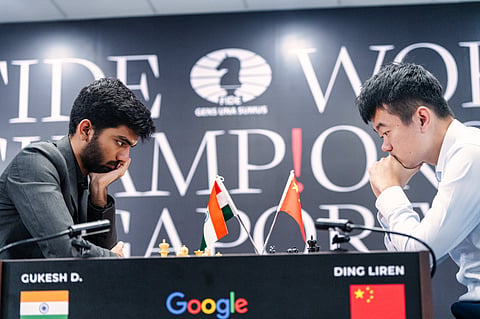

SINGAPORE: In the weeks after Singapore won the right to host the World Championship, they had two main requests. Allowing spectators to carry mobile phones at all times was one. And for the broadcast to have no delays. "This was the most commercially attractive set-up for spectators," Kevin Goh, head of the Local Organising Committee, told this daily.
Both of them could have created specific problems and that's why the LOC and FIDE — the world governing body for chess — discussed it at length. While the world body signed off on the request for 'live' broadcast, the two organisations met halfway regarding mobile phones. "We understood that the mobile phones issue... there were complications we couldn't resolve," Goh, the CEO of the Singapore Chess Federation, said.
"Hopefully, one day we will have the technology to do it. The best way right now is for spectators to bring in their phones and take pictures and videos for the first 30 minutes before going out and depositing it."
FIDE and the LOC, though, were aligned when it came to ensuring there would be no broadcast delays. It might seem outrageous to suggest not having live broadcast as normal but this is chess in 2024. One regular anti-cheating measure in place at other tournaments is to have deferred transmission (this measure was also present at the Candidates early this year).
The organisers ensured no delays after putting an elaborate security mechanism in place. It's so thorough the devices would detect if the players have as much as a cold.
The process
Once the players go down to the playing hall, they are ushered down the corridor and into the players' lounge. From the lounge till the time they enter the fish tank, multiple devices are employed to scan them.
The first layer is the basic frame you see in airports. That's the first security layer. Interestingly, that's so common at all tournaments Goh didn't even count it as a layer. Then comes the NLJD (non-linear junction device). There is also a thermal scanner as well as a device that picks up magnets. There is a fifth security apparatus the players face after the games are done.
"We all agree this is the best outcome for everyone," Goh said. "It doesn't make sense when you have live spectators sitting around and they are looking at it (the game) but the screens aren't live. This is an outcome everybody wanted. To try and balance everything."
Both camps were happy with the security arrangements FIDE had done.
