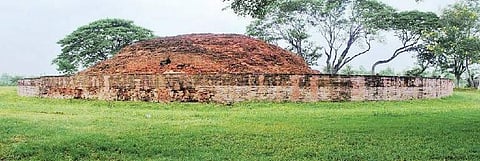

VIJAYAWADA: Caskets containing Buddhist relics dating back to the third century BC were unearthed at Bhattiprolu village in Amaravati region in 1892 by Robert Sewell, then collector, magistrate and in charge of archaeological department in the Madras Presidency under the British rule. Later, those relics were shifted to the government museum of Egmore in Chennai, where they have been left uncared for and unnoticed.
Buddhist scholar and CEO of the Vijayawada Cultural Centre, Eemani Siva Nagi Reddy, and State archaeologists noticed these relics preserved in a poor condition at the museum and appealed to the State government to hold a dialogue with the Tamil Nadu government for the transfer of those relics to Amaravati.

This Amaravati Stupa, which is also known as Mahachaitya Stupa, has the distinction of being the largest Stupa (95 ft high) in India - the birthplace of Buddhism - Reddy said, adding that the relics were found at the Stupa.
The State archaeological department and the Andhra Pradesh Tourism Development Corporation had in fact asked the Tamil Nadu government to transfer those relics to Andhra Pradesh in 2004. But, their appeal was denied. “All five relics were pathetically placed along the walls of the Amaravati Gallery in Egmore museum of Chennai. They have to be placed and displayed on pedestals with labels and legends,” E Siva Nagi Reddy said.
According to him, these relics have a lot of importance. Amaravati was once the capital of the Satvahana rulers. For Buddhists across the world, this Mahachaitya is an important pilgrimage as this location was once known as Amareswaram. The place is also identified as Dhanyakataka by several scholars, who connect Amaravati with the origin of many Tantric teachings especially, Kalachakra.
Nagi Reddy explained that the relics are priceless, the Prakrit inscriptions engraved on the stone caskets resemble the characters of Ashokan edicts and are rendered with Mauryan polish.
Robert Sewell, during excavation on the top of the Mahachaitya, discovered a stone relic chamber complete with a clay bowl which contained a crystal pearl, some ashes and bits of gold leaf.
He found another globular stone casket and, two small vessels containing a crystal prism, gold flowers, bits of copper, copper ring, pearls, gold beads, pearl beads and, silver coins arranged in swastika shape. Under all five stone relics, there were gold leafs, silver coins, pearls and beads. But, their whereabouts are not known. Only stone relics are now at the Egmore museum. Siva Nagi Reddy and state archaeologists are appealing to the govt to talk with the Tamil Nadu to get back those relics and place them at Kalachakra museum or Baudhasri archaeological museum until a state museum is built in new capital.