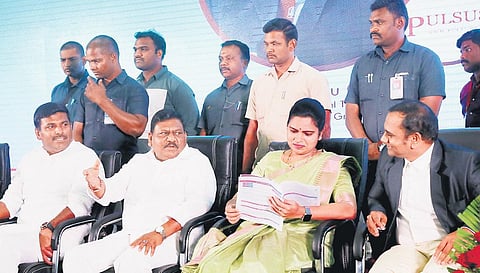

VISAKHAPATNAM: Investing in education and training programmes that equip workforce with the future-ready skills in the ever-changing job market and current digital economy is a must, said Minister for IT and Industries Gudivada Amarnath. He was speaking as a chief guest at the inaugural session of the two-day Global Tech Summit, which commenced in Visakhapatnam on Thursday.
The IT Minister mentioned that with the rapid advancements in technology, automation and artificial intelligence are becoming almost ubiquitous in the workplace, necessitating the creation of new jobs in the fields of data analysis, software development, and cybersecurity, while displacing the workers in industries like manufacturing, retail, and transportation.
To tackle this, we must focus on building a workforce that is adaptable, resilient, and skilled in the latest technologies, he opined, adding that prioritising retraining programmes that help workers transition into new industries and provide support to those who have been displaced is needed.Minister for Health, Family Welfare and Medical Education Vidadala Rajini said digital technology has transformed the way one lives, works, and learns.
“And now, it is transforming the way we approach healthcare and medical education. Digital health has the potential to improve healthcare outcomes, reduce costs, and enhance the overall patient experience. One of the most significant benefits of digital health is the ability to provide personalised and remote care to patients,” she explained, adding that it includes telemedicine, remote patient monitoring, and virtual consultations.
She mentioned that patients can now receive medical advice and treatment from the comfort of their homes, without having to travel to a hospital or clinic.The Health Minister opined that digital health also has the potential to transform medical education as it provides new and innovative ways to deliver medical education to students and practitioners.
“With the rise of online courses and simulation-based learning, medical students can now learn in a more flexible and interactive way. Simulation-based learning is particularly exciting because it allows students to learn in a safe and controlled environment.
They can practice medical procedures and treatments without the risk of harming real patients. This is especially important for high-risk procedures and treatments that require a high level of precision,” she further explained.
Day 1 of the summit featured a Digital Bharat Session on ‘Embracing Technology and Empowering Society’ conducted by the Federation of Indian Chambers of Commerce and Industry (FICCI).
Pragya Chaturvedi, senior intellectual property advisor at British High Commission, New Delhi, discussed Indo-British technical collaboration, trade and the opportunities available to the Indian startups and companies.
Srinubabu Gedela, CEO of Pulsus Group and co-convener of the Global Tech Summit, said this is a kickstart to the year-long series of events in the G20 countries with one summit every month to showcase opportunities in AP, particularly in Visakhapatnam.
