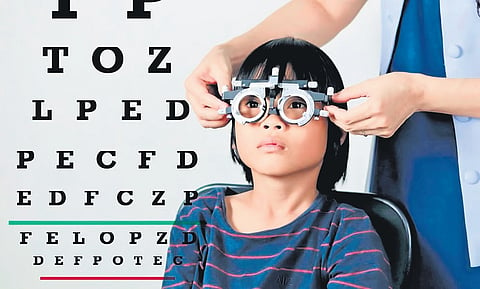

GUNTUR: Every school day, 3.4 million Indian children attend classes with uncorrected vision, struggling to keep up due to refractive errors like short or long-sightedness and astigmatism. These conditions prevent children from seeing blackboards and reading books clearly, causing them to learn significantly less than their peers.
In recognition of World Sight Day 2024, new research titled ‘Learning and Economic Productivity Losses from Uncorrected Refractive Error in Schools’ was released by the International Agency for the Prevention of Blindness (IAPB) and the Seva Foundation, a global non-profit health organisation. This study, based on a systematic review and meta-analysis of randomised controlled trials, reveals that a child with uncorrected poor vision learns approximately half as much as a child with clear or corrected vision.
Seva Foundation chief economist, Brad Wong, highlighted the potential gains: “With this first global estimate of learning losses due to poor vision, we see just how much children could achieve with timely access to glasses. India stands to gain 1.2 million schooling years, far exceeding China and Brazil, which stand to gain 7,30,000 and 3,10,000 schooling years respectively.”
The economic implications of this research are substantial. According to the study, Indian kids who receive glasses in school could each earn up to Rs 4,83,000 more over their lifetimes, improving their quality of life and academic performance. If a child is provided with glasses in primary school and wears them consistently until age 18, they are projected to earn 55.6% more over their lifetime than if their vision remained uncorrected.
Correcting kid’s vision could add 1.2 million schooling years to India annually, resulting in a potential economic productivity boost of `156 billion. This underscores the individual learning loss for children with uncorrected vision, which translates into a measurable reduction in the country’s GDP per capita.
IAPB Chief Executive Officer (CEO), Peter Holland, emphasised, “Early intervention, regular eye checks, and access to good quality eye care are essential for unlocking educational and economic opportunities for children. Eye health is critical, not optional, for securing their future success.”
