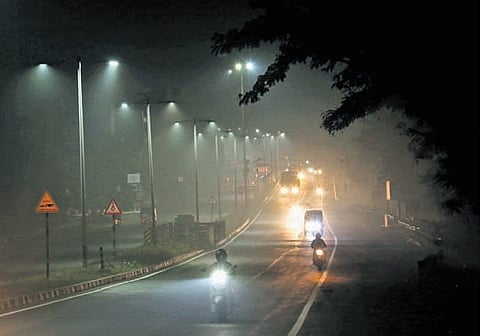

VISAKHAPATNAM: The air quality in Visakhapatnam city remained in the moderate category during the reporting period from December 15 to 21, 2025, according to the Weekly Air Quality Index (AQI) report released by the Andhra Pradesh Pollution Control Board (APPCB).
The APPCB compiled the report using data collected from nine ambient air quality monitoring stations across the city.
The report prepared identified particulate matter PM10 and PM2.5 as the dominant pollutants affecting air quality during the week.
The port city’s average AQI stood at 187, indicating moderate air quality.
However, several locations recorded poor and very poor levels, raising public health concerns, particularly for sensitive groups. The GVMC Office at Asilmetta recorded the highest pollution level with an AQI of 308, placing the area in the very poor category.
This level indicates risks of respiratory illness on prolonged exposure and poses serious concerns for people with existing lung and heart conditions.
Ganapuram recorded an AQI of 240, while the Police Barracks and the Industrial Estate at Autonagar recorded AQI values of 223 and 217 respectively.
These locations fall under the poor category. Officials attributed the elevated particulate matter levels to heavy vehicular movement, industrial activity and dense population in these areas.Several residential and commercial areas recorded moderate air quality in the city.
Mindi reported an AQI of 147, Seethammadhara 132, Pedagantyada 137, and MVP Raithu Bazaar 157, all falling within the moderate range.
The ESI Hospital area at Malkapuram recorded an AQI of 197, close to the upper limit of the moderate category.
The Andhra Pradesh Pollution Control Board said that while moderate AQI levels are not hazardous for the general population, prolonged exposure may cause breathing discomfort for people with asthma, lung disease or heart conditions.
The board noted that particulate matter pollution remained the primary contributor to deteriorating air quality across the city. PM2.5 and PM10 are fine particles that can penetrate deep into the lungs and bloodstream, leading to respiratory and cardiovascular problems.
According to the AQI health advisory, moderate air quality can cause breathing discomfort to people with existing health issues, while poor and very poor categories pose risks even to healthy individuals on prolonged exposure.
