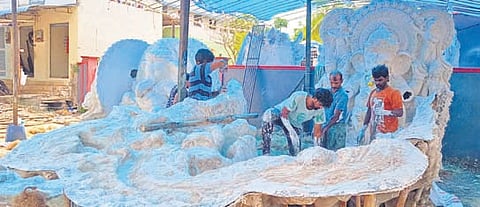

VIJAYAWADA: Large-scale Ganesh idols made using hazardous Plaster of Paris (PoP) are expected to flood the market once again this year. Artisans across both Krishna and NTR districts have already begun the production of these non-ecofriendly idols ahead of the Vinayaka Navaratri festival.
Idols ranging from 2 feet to 20 feet are being produced on a massive scale for the upcoming auspicious occasion. This year, the festival falls on August 26. An estimated 15,000 to 20,000 PoP idols are likely to be worshipped and immersed during the Ganesh Navaratri celebrations across the erstwhile Krishna district.
Keeping the festive season in mind, idol making began in June. Most idols are being made of PoP, along with materials such as coir and wood. To enhance their appearance, artisans are using a wide range of chemical-based colours. It is important to note that PoP poses environmental threat.
Many voluntary organisations, NGOs, and government officials have begun conducting awareness campaigns. However, the key concern raised is that most of these campaigns are launched only in the week leading up to the festival.
“These week-long campaigns serve limited purpose,” said an environmentalist from Vijayawada. “No one is taking the initiative to organise meetings or discussions with idol makers during the early stages of production. Idol-making usually begins 50 to 90 days in advance, depending on the demand. If NGOs and officials engage with artisans from the beginning, it will be more beneficial to both society and the environment,” the environmentalist added.
One of the artisans, Movva Durga Prasad from Machilipatnam, whose family has been involved in idol making for the past 150 years, said they earlier made clay idols.
“My grandfather and father used to make Ganesh idols with clay, wood, and other natural materials. But now, we are forced to use PoP because the government has stopped issuing quarrying permissions for clay,” he said. “Every year, we make 200 to 300 idols on demand. We used to quarry clay at Hanuman Junction, for which we paid taxes, but that has also been halted. Now, we import PoP from Rajasthan. Although PoP looks similar to clay, it does not dissolve easily. However, we are ready to return to clay idol making to protect the environment. Though it is time-consuming, we are committed to it,” he added.
Speaking to TNIE, Pollution Control Board Executive Engineer Srinivas said, “There is currently no ban on PoP idols. However, we are organising awareness campaigns to highlight the adverse effects of Plaster of Paris. We also distribute small clay idols during the festive season. We are hopeful that a ban will be imposed soon.”
