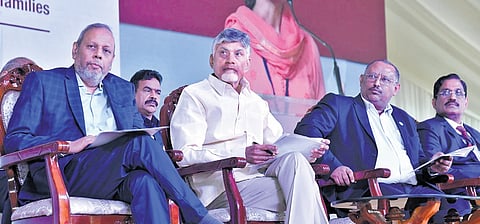

VIJAYAWADA: Chief Minister N Chandrababu Naidu has emphasised the need for population management rather than control. Observing that population is an asset, but not a burden, he said its growth will come in handy to realise the goals of Viksit Bharat and Swarnandhra Vision 2047.
Participating in the first Amaravati Summit on World Population Day held behind the State Secretariat on Friday, he underscored the need to increase the fertility rate to avoid scarcity of human resources. He said a robust policy on population growth will be introduced soon.
On the occasion, he launched a survey designed on the concept ‘Population management starts with every family. Your opinion is our policy guide’.
Emphasising that India’s ability to compete with developed nations is largely dependent on its population, he said, “Once, population was seen as a major problem. Before 2004, as the CM, I incentivized family planning. We even brought a law disqualifying those with more than two children from contesting local body elections. But today, there’s a need to amend the law to allow those with more than two children to contest the polls. A nation is not just about its land, towns or borders, it is about its people.”
Explaining the significance of Population Day, Naidu said, “Today, 1.8 billion people globally are aged between 10 and 24. Earlier, countries with large population were looked down upon. Now, even developed nations are compelled to look to populous countries. Population is not a burden, it is our greatest asset,” he observed.
Representation of South States in Parl could decline: CM
He expressed concern that while the global population is increasing, birth rate is declining, and the youth population is shrinking. Wherever aging becomes an issue, growth stagnates. Even in developed countries, fertility rates are falling.
The US has 1.62, the UK 1.54, Hungary 1.50, France 1.49, Russia 1.47, Germany 1.46, Canada 1.33, Japan 1.23, China 1.02, and Singapore 0.96. In rich nations, low birth rate is becoming the norm.
When the rate falls below 2.1, the population starts declining. In India, Bihar is at 3.0, Meghalaya 2.9, Telangana 1.8, and Andhra Pradesh 1.7. To maintain population equilibrium, a 2.1 rate is essential, he explained, revealing that a poll at the summit showed 67.41% preferred two children, 12.34% one, and 19.88% three. “Now, young people are reluctant to have children, and many couples are opting not to have any. The rising cost of living is discouraging people from having children,” he observed.
He noted that joint families were once common but are now disappearing. “There is a growing concern about the declining population in South India. While Parliament seats may increase in the future, Southern States could see reduced representation,” he cautioned. Asserting that he is pro-women, Naidu said many men still expect women to handle all household responsibilities, which is unfair. “Men and women are equal, and women are working just as hard as men,” he said.
