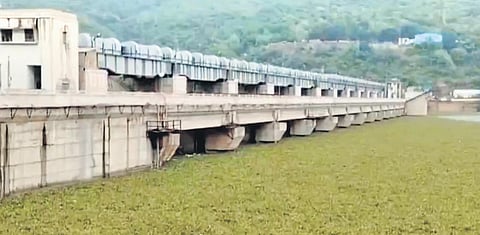

KURNOOL: With the Srisailam reservoir reaching its full capacity, the Water Resources Department officials lifted one radial gate on Monday to release water downstream to the Nagarjunasagar Project, marking the second release this year from Srisailam. However, a serious ecological issue has emerged in the reservoir’s backwater areas - the rapid spread of water hyacinth, locally known as Gurrapu Dekka Aaku.
Since Monday night, the invasive weed has been spreading rapidly across the water surface, transforming the area into a dense aquatic garden. Locals recall similar outbreaks in 2017 and 2018, but the current spread appears to be more widespread and aggressive. Environmental experts warn that if the hyacinth is not cleared within the next 20 days, it may begin to rot, degrading the water quality and potentially causing fish deaths and broader ecological harm.
“Water hyacinth typically grows in polluted water,” an environmental official explained. “Though the Krishna River brings fresh water to Srisailam, its tributaries like the Tungabhadra and Handri carry domestic waste, leading to this outbreak.” Health experts have raised concerns about contamination of water being pumped for pilgrims, as microbial activity in the weed layers could compromise safety.
Officials admit that the weed is clogging irrigation canals and water flow paths, and the Water Resources Department has so far struggled to contain the spread. Chief Engineer Khabeer Basha confirmed the appearance of the weed and noted that it likely originated from upper catchment areas due to heavy rainfall and from hill areas. The floating nature of the weed and shifting topography make it difficult to map and monitor accurately, he said, adding that removal measures will begin soon, with operations currently being planned.
According to Tuesday evening’s Irrigation department records, the reservoir had 212.380 TMC ft of water stored against its full reservoir level (FRL) of 215.807 TMC ft. Water levels reached 883.70 feet against the total 885.00 ft. Inflows reported 88,623 cusecs of water, while 1,17,276 cusecs of water are being drawn from the dam for different purposes.
