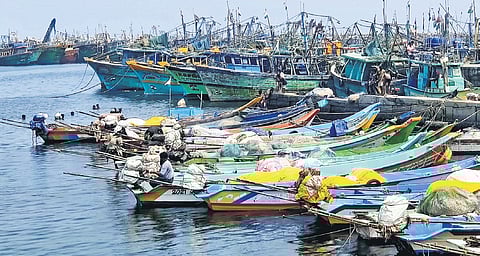

VISAKHAPATNAM: The National Federation of Small-Scale Fishworkers (NFSF) has opposed the government’s Blue Economy model, saying it threatens the livelihoods and traditional rights of small-scale fishing communities across India.
In a statement, NFSF President Pradip Chatterjee, General Secretary Sebastiao Rodrigues, and Joint Secretary D Pal said the Blue Economy framework effectively transfers ecological resources to corporate entities under the guise of development. They alleged that projects such as new ports, logistics corridors, real estate ventures, tourism zones, and industrial infrastructure are severely impacting coastal ecosystems and displacing traditional fishing communities.
The federation criticised the India Maritime Week 2025 conclave, describing it as a declaration of the invasion and occupation of India’s coastline. It said that behind the narrative of national development and global ambitions lies the exclusion of fishing communities from decision-making processes and the gradual erosion of their livelihoods.
According to NFSF, even after 78 years of independence, small-scale fishing communities have not been granted legal rights over the resources that sustain them, such as coastal lands, water bodies, rivers, wetlands, and fish stocks. This lack of recognition, the federation noted, has enabled the large-scale transfer of these resources to private corporations with state backing.
The organisation also raised concerns about the promotion of mechanised and capital-intensive fishing, which it said is depleting marine resources. Pollution, encroachment, and diversion of water for industrial use have further degraded inland and marine ecosystems. Industrial aquaculture, particularly intensive shrimp farming, was identified as a major threat to coastal ecology, groundwater, and public health.
NFSF said climate change is devastating small-scale fishers, causing loss of livelihoods, equipment, and habitat. It noted women suffer from the collapse of fish-drying activities. The federation urged protection of water bodies, recognition of fishers’ rights, a ban on destructive fishing and justice for affected communities.