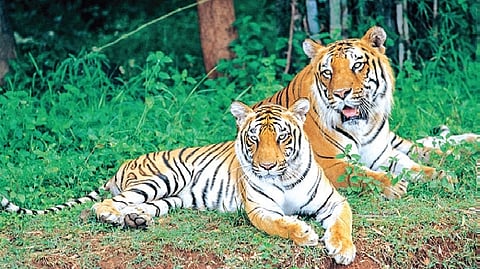

ONGOLE: The Forest department is drawing up an extensive plan to launch a major grass development programme in the Nagarjuna Sagar–Srisailam Tiger Reserve (NSTR), located in the Nallamala forest region, with the objective of boosting the population of herbivorous wild animals.
The initiative aims to increase numbers of deer, spotted deer, sambar, chinkara, wild buffalo and other grazing species, which form the essential prey base for carnivores, particularly tigers, within the reserve.
Spread across 5.95 lakh hectares, the Nallamala forest hosts India’s largest tiger reserve, spanning five districts: Nandyal, Prakasam and Palnadu in AP, and Nalgonda and Mahabubnagar in Telangana. However, despite its vast expanse, the prey base remains critically low. Official estimates indicate only around 18,000 herbivores, roughly three animals for every 100 hectares, far below what is required to sustain a healthier predator population. Forest authorities are now working on measures to double this number within the next two to three years.
NSTR covers 3,728 sq. km, including a core zone of 1,200 sq. km, and is home to an estimated 87 tigers. Experts believe the landscape has the ecological capacity to support 250–300 tigers, but the shortage of prey animals constrained the big cat population. To address this gap, officials have previously relocated herbivores such as cattle, antelopes and deer from other regions. In June 2024, 15 spotted deer and 28 sambar were transported from a private zoo in Kakinada to boost prey base.
As part of the ongoing “All India Tiger Estimation–2026” undertaken by the National Tiger Conservation Authority (NTCA) and the Wildlife Institute of India (WII), renowned grassland expert Dr Gajanan D Muratkar—known as the “Grass Man of India”—visited NSTR to assess habitat conditions.
He observed that the reserve’s grasslands were dominated by coarse, fibrous grasses that are unsuitable for deer and sambar. He recommended immediate interventions to cultivate soft, nutrient-rich grass varieties and improve water availability across the landscape.
“Dr Muratkar trained our staff in high-quality grass cultivation,” said NSTR Field Director Vijay Kumar. “We will remove invasive species such as parthenium, cassia tora and thorny bushes, and introduce soft, grasses like Saccharum spontaneum and Deenanath grass under a three-year action plan. These measures will help rebuild a strong prey base and create ideal breeding conditions for tigers.”
